Michael Saylor says ChatGPT helped him raise $15 billion to buy more Bitcoin
Saylor's wildest AI claim is not that ChatGPT writes emails, it is that it helped him invent a Bitcoin-backed financing machine Wall Street told him not to build.
Listen on YouTube · Spotify · Apple Podcasts
 WATCH NOW↓
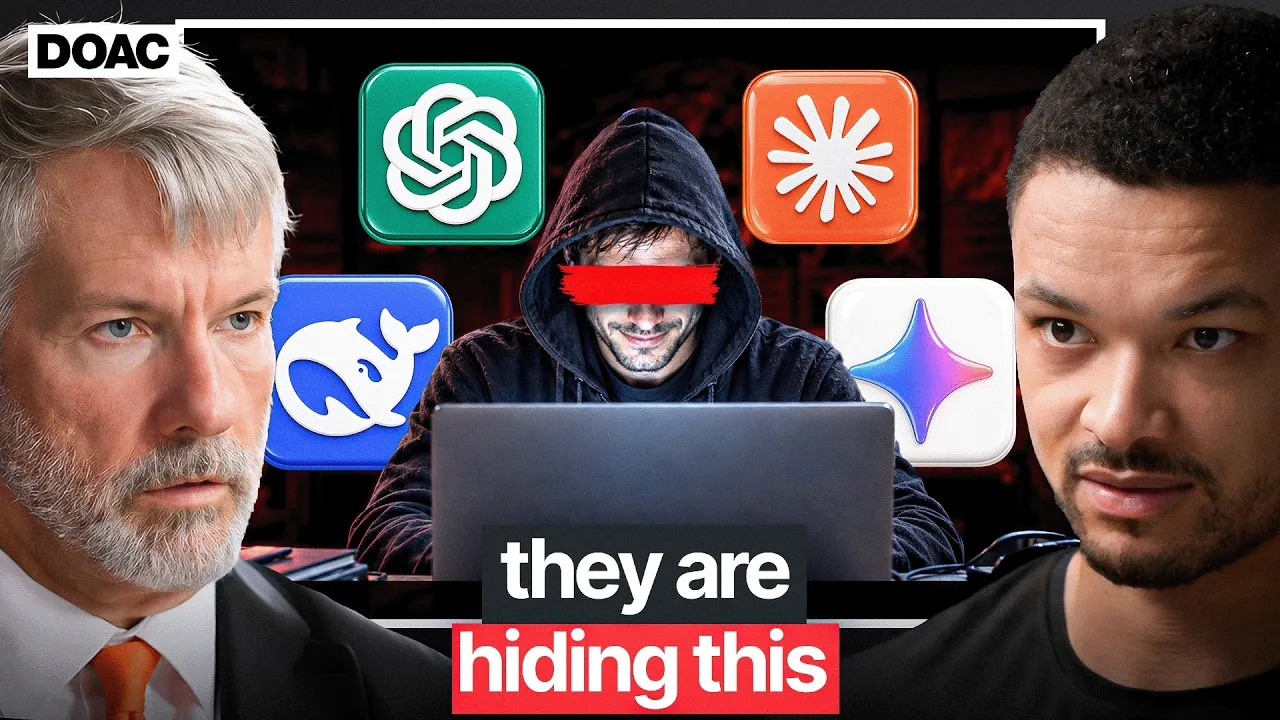
 Michael Saylor did not come on The Diary of a CEO to tell you ChatGPT made him 12 percent better at inbox zero. He says ChatGPT helped him raise about $15 billion so his company could buy more Bitcoin, which is either the best ad OpenAI never paid for or the most Saylor sentence ever assembled in a lab.
The claim arrives with the usual Saylor voltage, part MIT lecture, part CNBC fever dream, part wizard explaining why your broom has no yield. But underneath the flex is a real and specific argument about artificial intelligence: the people getting paid will not be the ones asking AI to summarize PDFs. They will be the ones using it to design weird new things that conservative institutions reject because nobody has blessed them yet.
لقد استخدمت الذكاء الاصطناعي لأربح 15 مليار دولار العام الماضي.
That sentence is doing some peacocking. Saylor did not say ChatGPT went out and raised the money, charmed investors, filed the paperwork, and rang the bell while wearing a Patagonia vest. What he describes is stranger and more useful: his company had already exhausted the obvious routes for raising capital to buy more Bitcoin. So he went looking for a new financial instrument.
ChatGPT as investment banker, apparently
Saylor says the problem was simple in the way only a multibillion-dollar Bitcoin balance sheet can be simple. His company had issued common equity. It had become, by his telling, the largest issuer of convertible bonds in the world. The machine needed more fuel, and the old pipes were maxed out.
The answer, he says, was preferred stock, a flexible security that can be made to resemble debt, equity, or some uncanny corporate-finance centaur in between. Specifically, he points to STRK, a convertible preferred stock instrument, and then to another short-term credit-style product designed to trade close to par while paying a distribution rate the company could adjust.
This is where the Saylor story gets its bite. Lawyers and bankers, in his telling, did what lawyers and bankers are paid to do: they looked at the new thing and said, essentially, nobody does that. Saylor treated that not as a stop sign, but as a prompt.
ذهبنا إلى الذكاء الاصطناعي. قلنا:” حسناً، هل يمكننا القيام بذلك؟ ” أجابوا:” بالطبع يمكنك القيام بذلك. فقط افعل هذا، وهذا، وهذا، وهذا ، وذاك ”.
شات جي بي تي (Chat GPT). أوبن إيه آي (OpenAI).
There is a self-serving gloss here, obviously. Saylor has every incentive to frame his Bitcoin financing strategy as visionary rather than maximalist borrowing with better branding. He also has every incentive to make ChatGPT sound less like a chatbot and more like a junior Goldman Sachs team that never sleeps, never bills, and never asks whether the whole thing is too spicy for compliance.
Still, the distinction matters. The exaggerated version is: ChatGPT made him $15 billion. The credible version is: Saylor used ChatGPT to explore a legal and financial design space faster than his human advisers were willing to. That is not as memeable. It is probably closer to the truth.
بشكل أساسي، بعنا 15 مليار دولار من الائتمان، وهو ما يعادل تقريباً تحقيق الشركة حوالي 15 مليار دولار.
The AI lesson is harsher than the headline
Steven Bartlett tries to bring this back to normal human scale, the person listening who wants a business idea and maybe does not currently control billions in Bitcoin. Saylor’s answer is not a cozy productivity tip. It is closer to career triage.
If you’re building something, Saylor says, the point is not to learn tasks AI can already perform. It is to learn how to ask for the thing civilization has not already solved. That sounds grandiose, because Saylor rarely uses a candle when a flamethrower is nearby, but the practical advice is crisp: don’t compete with AI at clerical work. Use it to search the boundary of what is newly possible.
This is why his college advice gets so brutal. He says he would not study surgery, law, accounting, or driving if he were starting now. He is not predicting that every surgeon is toast by Thursday. He is saying that high-status paths are dangerous if their core skill can be decomposed, modeled, and automated.
إذا عدت إلى المدرسة، فربما لن أرغب في دراسة 95%مما تعلمته.
The funny part is that Saylor’s own example is not exactly democratizing. A baker in Lagos, a firefighter in Los Angeles, and a public company with a giant Bitcoin treasury do not all get the same magic wand. AI may help anyone ask better questions. It helps a lot more when the answer can be converted into securities filings, investor demand, and another mountain of Bitcoin.
So yes, the claim is inflated. It is also the rare inflated podcast claim with an actual mechanism inside it. Saylor is not saying ChatGPT gave him a listicle called 10 Side Hustles for 2025. He is saying it helped him find a financing structure human gatekeepers treated as too unfamiliar to bless. If that version is right, the arbitrage is not ChatGPT. The arbitrage is asking it the question everyone else is still waiting to ask a committee.
- What did Michael Saylor say ChatGPT did for him?
- Saylor said he used ChatGPT while designing new preferred stock instruments after his company had already pushed hard into equity and convertible debt markets. His version is that AI helped explore whether a novel Bitcoin-backed security could be structured legally and financially, even when traditional lawyers and bankers were uneasy because they had not seen it before.
- Did ChatGPT literally make Michael Saylor $15 billion?
- Not literally. Saylor's stronger, showier phrasing makes ChatGPT sound like a money printer, but his own explanation is more specific: the company sold roughly $15 billion of credit through instruments he says AI helped him design. The real story is AI as a high-speed structuring assistant, not AI replacing capital markets.
- Why is Saylor's AI claim important?
- Because it moves the ChatGPT conversation away from homework, copywriting, and productivity hacks into public-company finance. If Saylor's account is accurate, the edge is not asking AI for a business idea. It is using AI to probe the edge of what a regulated market allows before everyone else gets comfortable doing the same thing.
Nate Soares says humanity would be lucky to have 10 years unless we stop building superintelligence
The AI safety researcher’s doomsday clock is blunt, but his stronger argument is that a global pause might actually be enforceable because frontier AI training is huge, scarce and visible.
Brian Greene says by the time we see an AI intelligence explosion, it may be too late to stop it
The physicist is not buying every 2029 superintelligence prophecy, but he thinks the math of exponential growth is exactly what makes AI risk so nasty.

Ian Bremmer says Anthropic's new AI model is dangerous to all of us globally
The geopolitical-risk expert argues that AI needs the same kind of emergency oversight finance got after crises, and he points to Anthropic as the warning flare.

Daniel Kokotajlo says mass unemployment starts in 2028 or 2029, after AI companies automate themselves first
The former OpenAI researcher argues that the scary part is not today’s chatbot taking your job, it is AI labs building superintelligence before the labor market even knows what hit it.
The circuit, read weekly. No noise.