Oakley Robbins says he had to go no contact with his girlfriend to stop hating college
The useful part of this Mel Robbins episode is not positive thinking, it is the brutal little admission that an escape hatch can keep you miserable.
Listen on YouTube · Spotify · Apple Podcasts
 WATCH NOW↓
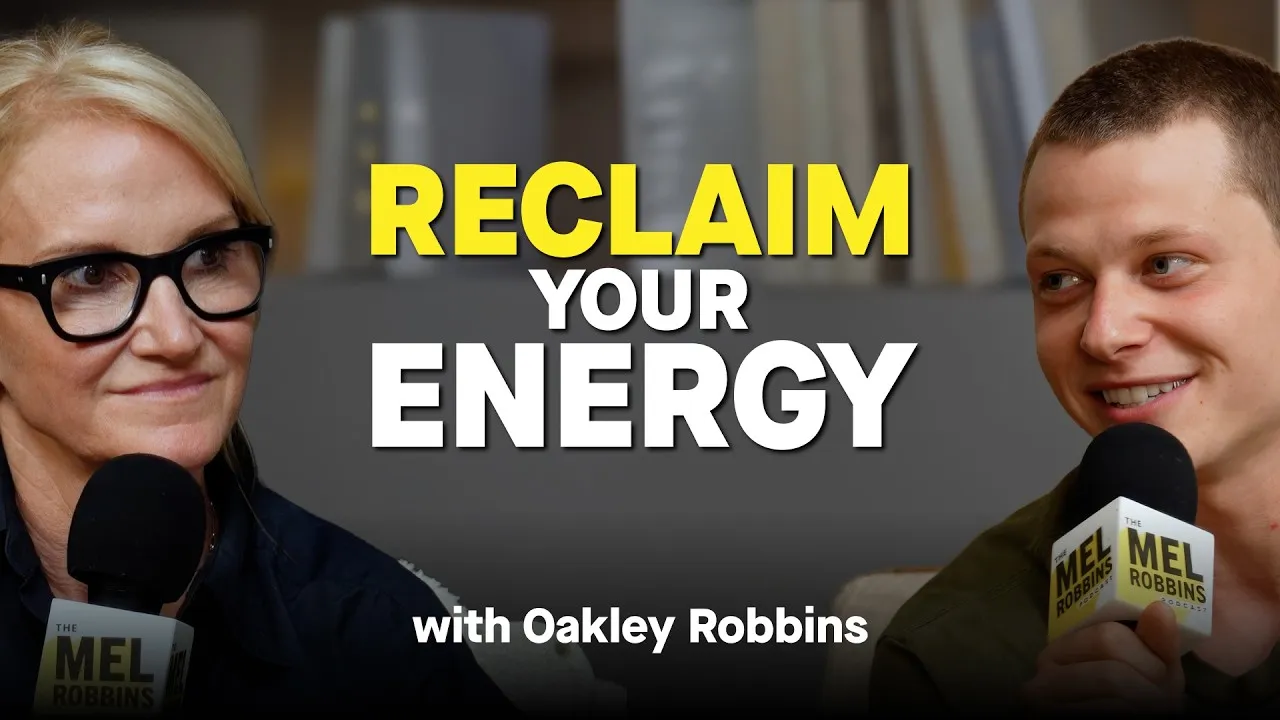
 Oakley Robbins, Mel Robbins’s 21-year-old son, says the thing that finally made college bearable was not transferring, finding a magic friend group, or waiting for campus to become a John Hughes movie with better meal swipes. It was breaking up with his girlfriend and going full no contact so he could stop using the relationship as an escape hatch.
That is the actual claim hiding inside this very Mel-ish episode of The Mel Robbins Podcast, which is otherwise packaged as a checklist for figuring out whether your misery is about you or the situation. The checklist is neat enough to laminate. Stop comparing. Expand your energy. Go all in. Change something. But the moment that gives it teeth is Oakley Robbins admitting that his long-distance relationship gave him a socially acceptable way to avoid building a life at college.
The exit was the problem
Oakley describes arriving at college already homesick for the life he had just left: the high school where he felt known, the sports teams, the friends, the girlfriend, the whole golden-hour Vermont montage. He hated school for a year and a half. Not in the theatrical freshman way, but in the sitting-in-the-dorm-on-weekends, judging-everybody, waiting-for-something-to-happen way.
I needed to get off my high horse and stop assuming that the place I was in was going to become the place I was once at.
That is a clean sentence, and a useful one. It also sounds like something you only realize after wasting a truly heroic amount of time being right about your own unhappiness. Oakley says he had friends telling him to go out, join things, meet people. He didn’t want the obvious answer. He wanted proof that the campus was wrong for him.
The relationship complicated that. He had started dating shortly before leaving for school, and he says he thought about her constantly. Calls on Friday and Saturday nights became an exit ramp from the social life he said he wanted. In the moment, it looked like devotion. In retrospect, he frames it as avoidance.
I think it’s really unfair to criticize where you are if you don’t give it 100%.
Mel, to her credit, doesn’t turn this into a simple anti-relationship sermon. She compares it to her own move from the Boston area to Vermont, when she kept physically and mentally returning to the old life while blaming the new one for not feeling like home. The bigger idea is not that love ruins college. It is that any available exit, a person, a hometown, an imagined alternate life, can keep you from making the present tolerable.
No contact as self-help, somehow
Oakley says he and his girlfriend had already tried breaking up once, but they kept talking. Anyone who has ever called that arrangement “space” while checking their phone every four minutes knows how that movie ends. They got back together. The second time, he says, they chose no contact.
we made the choice that we we were going to burn the exit
That phrase, “burn the exit,” is the line people will remember, partly because it is dramatic and partly because it is true in the annoying way good advice often is. No contact was not framed as punishment. It was structural. Without the nightly emotional tunnel back to his old life, Oakley had to do the boring adult things: rejoin frisbee, go to parties, text the people you always say you should get lunch with, then actually get lunch.
The verdict: the claim is persuasive, with a giant asterisk. It is persuasive because Oakley is not selling no contact as a universal cure for breakups. He is describing a specific pattern: he was lonely, he had an exit, and as long as the exit stayed open, he didn’t have to risk rejection in the place he actually lived. The asterisk is that this is still self-help, so the messy parts get buffed into a four-step mirror exercise. Some college misery is a bad fit. Some jobs are bad jobs. Some cities are not secretly waiting to love you back.
Mel knows that, and she says the checklist cuts both ways: if you’ve stopped comparing, shown up fully, changed your behavior, and the situation is still dead, leave. That is the better version of self-help, less “fix your attitude” and more “collect better evidence before you blow up your life.”
The scary part is how long he could have stayed miserable
The most honest thing Oakley says is not that everything got better. It is that he had learned he could tolerate misery for a very long time. That should make every listener sit up a little straighter, especially anyone currently calling their avoidance “being patient.”
I I mean I wonder how many people are currently doing that, but I also I I I think I could have done it longer as well, which also scares me.
Eventually, Oakley says, the new life clicked in the least cinematic way possible: a regular day, practice, food, then sitting in a car in the pouring rain for four hours talking with a friend. Not a breakthrough seminar. Not a vision board. Just a friendship becoming real because he had finally put himself where friendship could happen.
If his claim is true, the practical stake is uncomfortable. Before you decide the school is wrong, the job is cursed, the city is soulless, or the relationship is doomed, ask whether you are still keeping a warm little tunnel back to the old version of your life. If the tunnel is open, you may not be trapped. You may be commuting.
- Did Oakley Robbins say he transferred colleges?
- No. Oakley says he stayed at the same school. The change he describes was behavioral: he stopped comparing college to high school, rejoined the frisbee team, started saying yes to plans, and cut off the relationship that had become his fallback.
- Why did Oakley Robbins say no contact mattered?
- His point is that a breakup with constant texting is not really a closed door. He says he and his girlfriend had tried breaking up before, but because they kept talking, the old life was still available. No contact made him face the life in front of him.
- Is Mel Robbins saying every unhappy college student should break up?
- No. The advice is narrower than that, thankfully. The stronger claim is that you can't fairly judge a school, job, relationship, or city while keeping one foot in an old life and using that old life to avoid the present one.
Mel Robbins says the Red Sox are making their first bobblehead honoring a woman for her Let Them Night
The summer-reset episode mostly sells anticipation as self-care, but the searchable nugget is a Fenway promo claim big enough to make Red Sox fans squint.
Mel Robbins says your life is an average Tuesday, not the big moments you keep waiting for
The self help star's best reminder is also the least glamorous one: stop treating ordinary days like filler.
Rahul Jandial says acting out your dreams can warn of Parkinson's 15 years early
The neurosurgeon’s strongest claim is not that dreams are mysterious, it is that some dream behavior belongs in a sleep clinic, not a dream dictionary.
Oprah Winfrey says agreeing to launch OWN was one of the biggest mistakes of her life because she ignored her instincts
On Mel Robbins, Oprah reframed OWN's painful early years not as a business misfire, but as a people-pleasing failure.
The circuit, read weekly. No noise.