Rizwan Virk says UFOs may be conditionally rendered like objects in a video game
The simulation-hypothesis author turns alien abductions, fairies, jinn, ghosts, and UFOs into one very strange rendering problem.
Listen on YouTube
 WATCH NOW↓
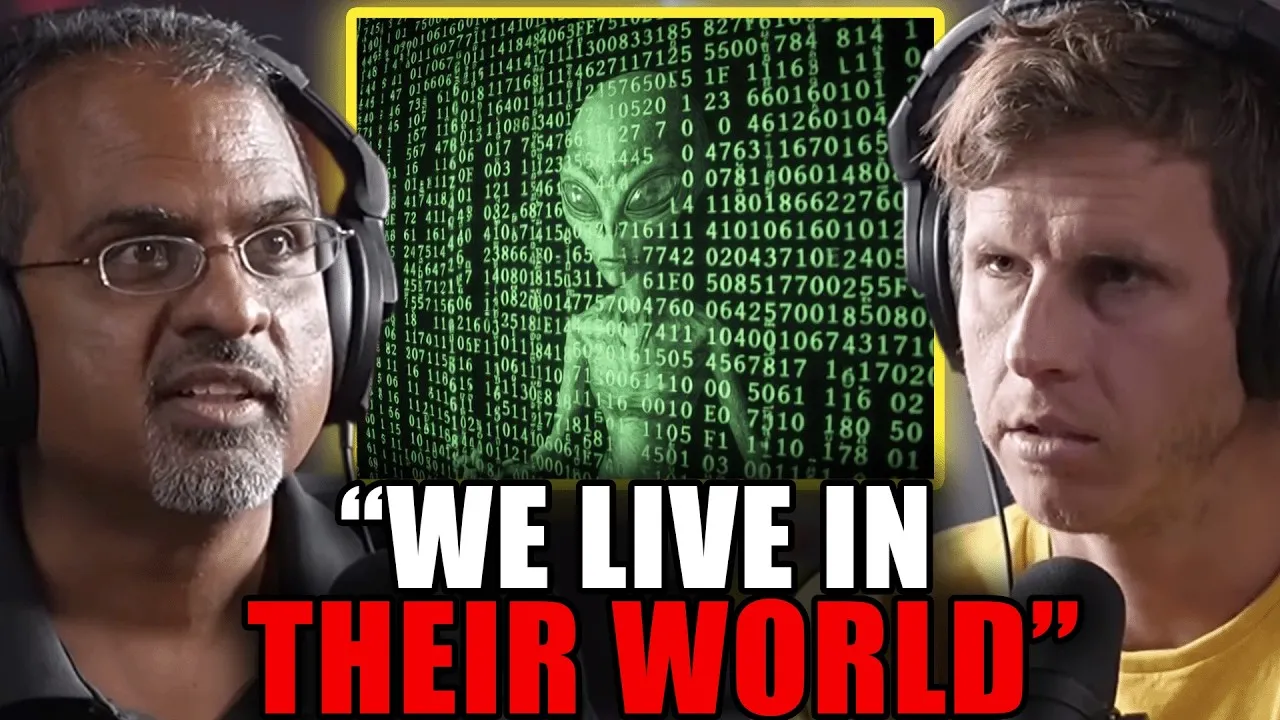
Rizwan Virk told the Danny Jones Podcast that some UFOs may be “conditionally” rendered into reality, visible to certain people but not others, like objects in a video game. Virk’s claim is that alien encounters, ghosts, fairies, jinn, and flying saucers may be different skins on the same non-human phenomenon inside a simulated world.
This is the kind of theory that sounds insane for three seconds, then starts behaving like a Roomba in your brain, bumping into folklore, religion, abduction stories, and every “my kid saw the ghost but I didn’t” anecdote you’ve ever heard. Virk, a video game developer and author associated with the simulation hypothesis, is not saying every flying saucer is a spaceship from Zeta Reticuli with cupholders. He is saying our categories may be embarrassingly provincial. The fairy becomes the alien. The jinn becomes the hybrid mother. The chariot in the sky becomes the disc. Same weird visitor, new user interface.
Now, I’m not saying the beings aren’t there. I think they are there are non-human intelligences that are here.
That line matters because Virk is not doing the standard debunker shuffle, where the supernatural gets filed under sleep paralysis, swamp gas, and people needing better hobbies. He is making a bigger, slipperier move. The entities are real, he says, but their form may be adaptive, almost theatrical. In the 1950s, contactees said the visitors were from Venus because Venus still had room in the popular imagination for mystery. Today, the visitors look like grays because we have spent decades letting pop culture sand the alien down into that smooth little almond-eyed mascot.
The alien as an avatar problem
Virk’s strongest move is dragging old folklore into the same room as modern alien abduction lore. He brings up Celtic stories of fairies taking humans into another world where time moves differently, Islamic stories of jinn living alongside humans, and a tale of a man whose jinn wife takes their children and vanishes back to her realm. Danny Jones answers with the documentary Love and Saucers, about David Huggins, the artist who claimed he lost his virginity to an alien woman and fathered hybrid children. It is, somehow, the most Danny Jones possible footnote.
And is it possible these entities can present themselves to look human, or to look like a particular race of aliens, but they may or may not actually be aliens?
The useful part of Virk’s theory is not that it proves aliens are fae with a software update. It doesn’t. The useful part is that it explains why the stories rhyme so strangely across centuries while changing costume with the era. Medieval villagers get fairy realms. Midcentury Americans get Venusians. Late 20th-century experiencers get sterile rooms, egg extraction, and bug-eyed technicians. The wardrobe department is suspiciously responsive to the audience.
The weak part is also obvious. Once “presentation” becomes elastic enough, every contradiction becomes evidence. If the being looks human, that’s the avatar. If it looks alien, that’s the avatar. If one witness sees a saucer and another doesn’t, conditional rendering. If it passes through trees, the mesh hasn’t fully loaded. This is a beautiful theory because it can absorb everything. That is also why it should make your eyebrow climb halfway up your forehead.
The saucer that loads like a glitch
The most searchable nugget here is Virk’s “conditional rendering” idea. In games, two players can occupy what feels like the same world while the server gives them different information. One sees an object. Another doesn’t. One is “level 30,” to use Virk’s example, and the other is not cleared for the asset. Virk applies that to UFOs, ghosts, and altered states, suggesting some phenomena may be there only for people able to perceive them.
It’s almost like they can render in our simulation.
Conditionally means they’re they’re there for the people that are able to perceive it.
That is a terrific podcast sentence. It is also doing the hard work of turning a lack of shared evidence into a feature. Virk points to cases he attributes to Jacques Vallée and Garry Nolan in which witnesses allegedly see different shapes, or some family members see an aerial object while others do not. He also brings in a ghost story from Leslie Kean’s Surviving Death, where a child can see and talk to a woman in the house while the parents only glimpse her.
Then comes the redwood story, the one that feels written by an Atari programmer with a paranormal streak. Virk says Vallée told him about a UFO landing case in Northern California or Southern Oregon where the object supposedly came down at a 45-degree angle. The problem: that path would have taken it through redwood trees. According to Virk, the witnesses said that is exactly what happened, but they did not want to say so because it sounded too crazy.
Now that to me sounds like like when you’re rezzing something in a game, you know, there’s that period where it’s not fully rezzed and you can actually walk through walls and stuff until it’s gets locked into the 3D world.
As evidence, this is vaporous. As a metaphor, it is sticky as hell. Virk is giving paranormal culture a new operating system. Not aliens as astronauts. Not ghosts as dead people in nightgowns. Not fairies as tiny winged etiquette violations. Instead: non-human intelligences with some ability to enter, skin, and manipulate the rendering layer of reality.
The verdict is simple enough without pretending the mystery has been solved. Virk’s claim is not proof of a simulated universe, and it does not rescue every abduction story from skepticism. But it does identify the strangest common feature across these reports: the phenomenon often seems customized to the witness. If he is right, the listener’s next question is not “Where are they from?” It is much creepier: why did the system decide you were allowed to see them?
- What did Rizwan Virk say about UFOs and simulation?
- Rizwan Virk said UFOs and non-human entities may be appearing through something like conditional rendering in a simulation. In his version, an object or being could be visible to one person and invisible, or different-looking, to another, depending on perception or access, much like different players in a game seeing different assets.
- Does Rizwan Virk think aliens are real?
- Virk says he does think non-human intelligences are here, but he resists the simple idea that every encounter is just visitors from another planet. He suggests the beings may present themselves in forms humans can understand, from fairies and jinn to Martians, Venusians, grays, and spaceships.
- What evidence did Rizwan Virk use for the conditional rendering idea?
- He pointed to UFO and ghost reports in which different people allegedly perceive different things, plus a Jacques Vallée case where a UFO supposedly passed through redwood trees while landing. Virk reads those stories through the logic of game design, where objects can appear, load, and become solid only after they are rendered.
Darcy Weir says the US Air Force planned to nuke the moon in 1958 to flex on the Soviets
The UFO documentary filmmaker revisits Project A119, a Cold War scheme that proves our actual space history is much weirder than the flying saucer rumors.

Darcy Weir says Corey Goode admitted in a 2022 deposition he has never been to space
The UFO filmmaker says Goode's secret space program story runs into one very earthly problem, a deposition clip and a DMCA fight.
Nathaniel Gillis says Chris Bledsoe's 'Merlin' label means a category of UFO contactee, not the wizard
On Danny Jones Podcast, Gillis turns the goofiest-sounding Bledsoe lore into a darker theory about government study, contactees, and weaponized ridicule.
Daniel Whiteson says the Princeton simulation evidence is a cosmic-ray glitch thought experiment, not proof
The physicist likes the sci-fi of it, but he treats the viral simulation claim less like a smoking gun than a very nerdy stress test for reality.
The circuit, read weekly. No noise.