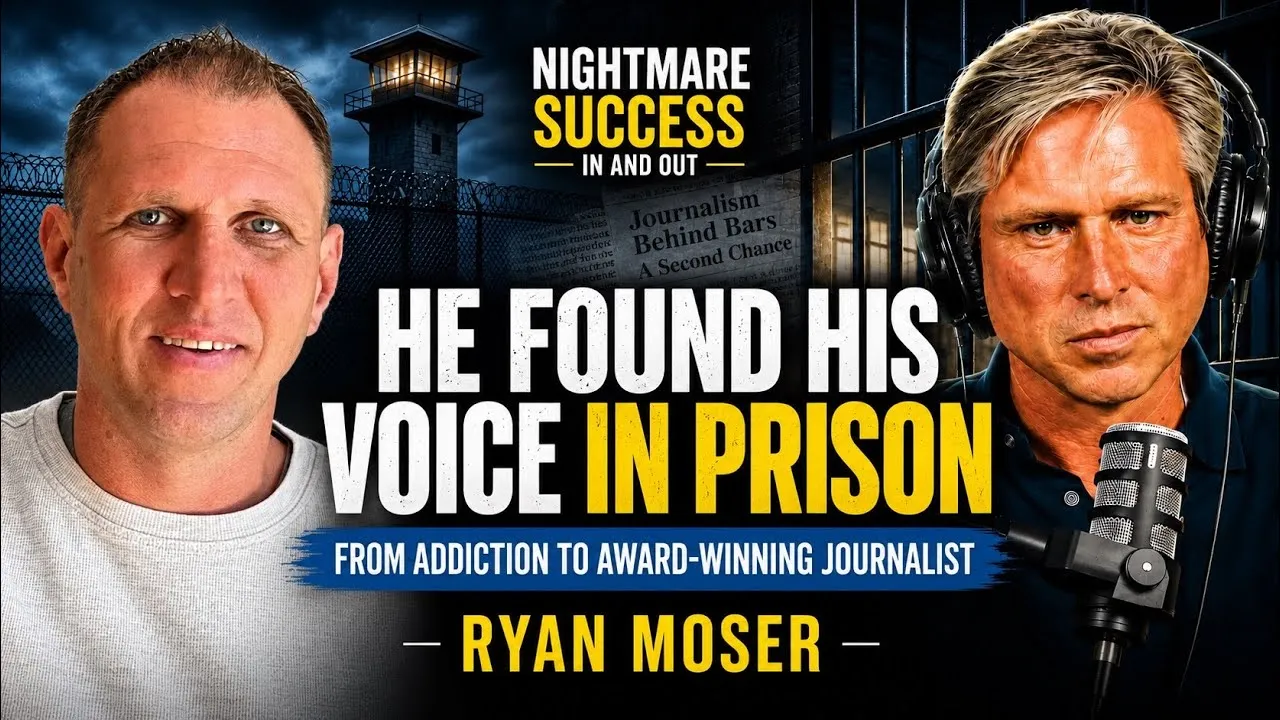
Ryan Moser says prison journalism let him leave prison with $10,000 and a career
The former incarcerated writer tells Nightmare Success that bylines, mentors, and paid prison journalism gave him a reentry plan most people never get.
Listen on Nightmare Success · YouTube
 WATCH NOW↓
 Ryan Moser says prison journalism let him leave an eight-year Florida prison bid with about $10,000, a clip file, and a career path waiting outside. That is the rare reentry story where the miracle isn’t a motivational poster, it’s a byline.
On Nightmare Success, host Brent Cassity admits he assumed Ryan Moser had been a journalist before prison. Nope. Moser’s story is more irritating to every polished media striver than that. He says he was a high school dropout, an addict, and a repeat prisoner who found the profession inside, first through writing classes, then through the prison press pipeline that turned his essays into published work.
The byline came before the door opened
Moser’s origin story as a reporter begins with an assignment he didn’t even want to write, a piece about waking up in prison called “Sunrise Over Me.” His instructor pushed him toward the obvious thing he was resisting. People did not need another vague inspirational essay. They needed the view from the bunk, the noise, the threat, the officers, the miserable texture of the place.
I had no idea what journalism was about. No clue.
That ignorance is part of why the claim has bite. Moser isn’t selling the cozy fantasy that prison unlocked some fully formed Hemingway hiding under a jumpsuit. He names the scaffolding: Exchange for Change, The Marshall Project, Prison Journalism Project, and Empowerment Avenue. The romance is the least important part. The infrastructure is the story.
I stepped right out of prison and right into journalism
That’s a gorgeous sentence, and also a little dangerous if you sand it down into prison TED Talk paste. Most people do not step right out of prison and into anything except paperwork, job rejections, housing barriers, and the particular American hobby of telling people they have paid their debt while continuing to charge interest forever. Moser did not beat that alone. He had mentors. He had programs. He had published work. He had a support system. He had something else almost nobody has when they come home: cash.
I was making money. I mention I left with about $10,000 thanks to Empowerment Avenue.
This is not a bootstraps fairy tale
The verdict here is yes, Moser’s claim is credible, and no, it should not make anyone feel warm and efficient about prison. He is very clear that the normal version of incarceration is not a writers’ residency with worse food. He describes juvenile detention as violent, adult prison as worse, and Florida corrections as broken. The exception that helped him was an incentivized prison with classes, relative safety, and a culture where writing could become more than killing time.
He also punctures the dumbest recovery myth, the one where prison automatically equals sobriety because the doors lock. Moser says the opposite. During his father’s death, the man next to him was selling opiates.
I could get drugs as easily as easier like you said easier than when I was home.
That line matters more than any polished slogan about addiction. Writing did not magically cure him. It gave him friction against the slide. It gave him a reason to handwrite three copies of everything, one to keep, one to send home, one to submit. It gave him editors, deadlines, feedback, and the deeply unglamorous thrill of being treated like a person whose sentences mattered.
Cassity keeps circling the same word, purpose, and for once the word earns its rent. In Moser’s case, purpose is not misty self-help fog. It has receipts: published essays, fellowships, conference scholarships, a portfolio on Muck Rack, work in The Philadelphia Inquirer, and even the strange second act of photographing concerts after prison. The rock star dream didn’t happen. The photo pass did.
The harder truth is that Moser’s path is both inspiring and indicting. If prison journalism can help one man leave with money, identity, and a professional network, then the scandal is not that his story is exceptional. The scandal is that the system makes it exceptional.
I am one step away from one decision away from ruining my life and my son’s life and my fiance’s life and my family’s life.
- Was Ryan Moser a journalist before prison?
- No. Moser says the opposite. He describes himself as a high school dropout with no serious journalism background, then credits prison writing classes, The Marshall Project, Prison Journalism Project, and Empowerment Avenue with turning him into a working reporter.
- How did Ryan Moser leave prison with $10,000?
- Moser says he was paid for articles while incarcerated and left with about $10,000 thanks to Empowerment Avenue. That money helped him reenter with more stability than most people leaving prison, including the ability to buy a car.
- Does Ryan Moser say prison got him sober?
- Not in the simple way people like to imagine. He says drugs were easy to get inside, especially during grief, and that staying sober was an active choice tied to purpose, family, therapy, exercise, and daily discipline.
Jennifer Michele Helm says she found out she was federally indicted by email after smoking a joint in Laguna Beach
The former luxury interior designer describes federal fraud charges arriving not as a dramatic knock at the door, but as an email interrupting a very California morning.
Chad Marks says the Supreme Court killed the 924(c) compassionate release argument that freed him, and people are going back to prison
The jailhouse lawyer story is gripping, but the nastier reveal is that Marks says he escaped through a legal door just before it closed on everyone behind him.
Bruce Bryan says wrongful conviction cost him 29 years, but not his ability to become a thriver
The Nightmare Success episode sells Bryan’s story less as an innocence-case postmortem than as a startling argument about what a person can still build after the state takes three decades.
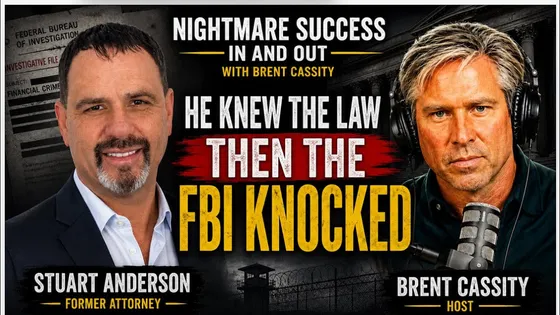
Stuart Anderson says admitting he saw red flags helped turn him into a federal fraud defendant
The former attorney says he thought he was helping investigators, then walked himself straight into the legal phrase every white-collar defendant learns too late.
The circuit, read weekly. No noise.