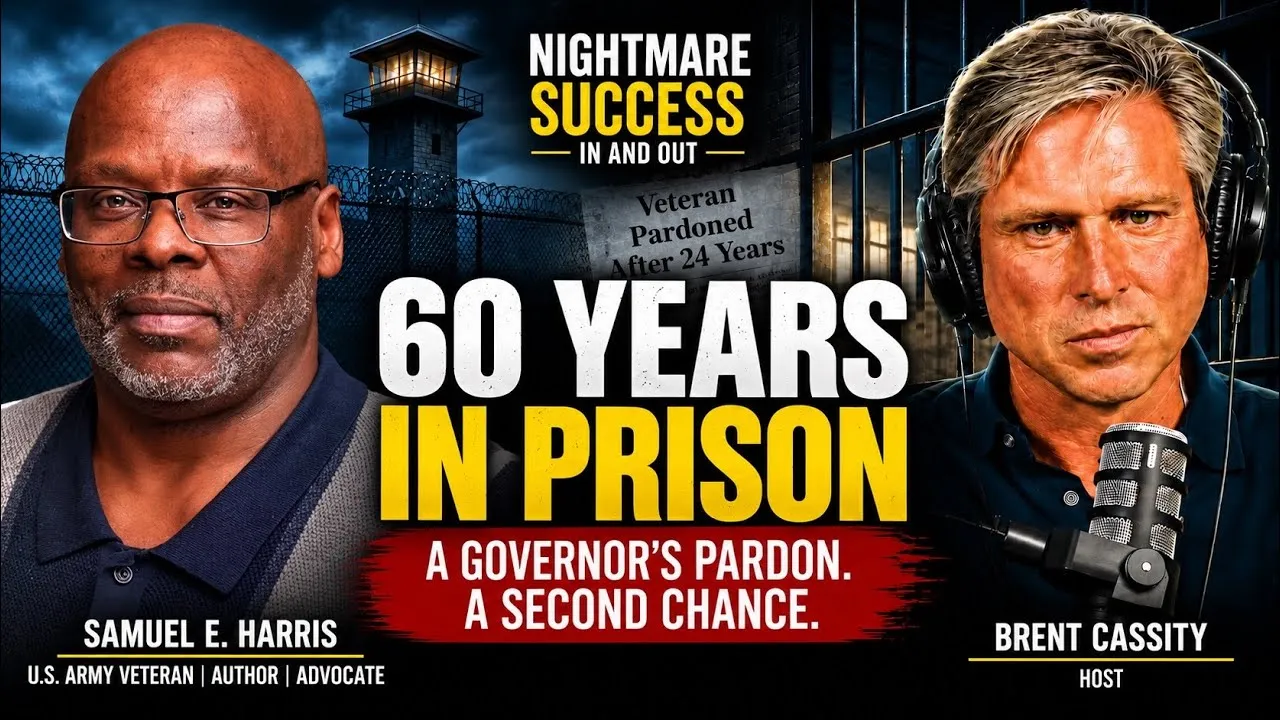
Samuel E. Harris says he wrote 1,084 prison letters before Governor Glenn Youngkin pardoned him
On Nightmare Success, Harris describes clemency less as a miracle than as a paperwork siege, after a 220-year sentence and 24 years behind bars.
Listen on Nightmare Success · YouTube
 WATCH NOW↓
 Samuel E. Harris says his pardon campaign had a numbering system, because hope gets very clerical when your release date says 2052. On Nightmare Success, Samuel E. Harris says he wrote 1,084 letters from prison before Governor Glenn Youngkin pardoned him, a detail that turns the usual soft-focus redemption story into something closer to a prison-yard version of The Shawshank Redemption, if Andy Dufresne had a spreadsheet and postage anxiety.
The terrible math matters here. Harris was not describing a symbolic sentence. He says a judge gave him 220 years, with 60 to serve, after a crack cocaine binge spiraled into a home invasion, robbery, abduction charges, stolen guns, and a stolen car. Harris does not tell it like a man asking you to squint until the crime disappears. He tells it like a man who knows the damage is the first fact on the page.
It actually sentenced me to 220 years with 60 to be served.
That is what keeps this episode from curdling into inspiration soup. Harris gives you the ugly part. He had been a U.S. Army veteran, he says, dealing with PTSD after a near drowning during a military exercise. He came home, drank heavily, got into cocaine, then crack cocaine, and by late 1999 was exhausted, addicted, and dangerous. None of that excuses what happened. It does explain why his later argument for clemency is not, I was really a good guy all along. It is, people can become someone else, but systems make them prove it in triplicate.
Hope with a filing system
Harris says he began preparing for a pardon after meeting another incarcerated man at Lawrenceville Correctional Center who had received one. His own petition was filed in 2018, denied in 2021, reopened in 2022, and granted in 2023. The denial scene is brutal in its small prison-specific etiquette. Good news has a choreography. Bad news slides under the door.
if it comes under the door is a denial. They call you outside you got it.
After that denial, Harris says, he did not go mystical. He went postal, in the literal mailroom sense. He wrote reporters. He wrote people he saw on PBS. He wrote a woman appointed to a governor’s council on mental health. He says one supporter eventually wore down officials at the Virginia General Assembly with his story. This is the real claim hiding inside the episode: pardons may look like lightning from the outside, but Harris presents his as the result of repetition, paperwork, timing, and a small army of people who refused to let his file stay dead.
I end up writing 1,084 letters. I would actually label my letters and I put a number
Is the 1,084-letter number independently proven here? No. It is Harris’s count, told on a podcast, and anyone writing the movie treatment should keep the grain of salt in frame. But it is also too weirdly specific to feel like generic redemption branding. The numbering, the denial letter, the Sunday mail, the computers glitching when the pardon appeared online, these are not the details of a man speaking in brochure copy. They are the details of a man who learned that bureaucracy is a door you sometimes have to annoy for years.
The pardon was not the ending
Harris says he was first disappointed that the pardon did not mean immediate release. Then, months later, he was told he was going home. He gives the exit timestamp like a man who has replayed it enough times to wear a groove in the memory.
July the 1st, I I walked out of there after 24 years, 8 months, and 10 hours inside.
What he does with that now is the less cinematic, more useful part. Harris talks about Walmart self-checkout feeling alien, keyless entry being hard to grasp, and learning to ask for help after mastering prison but not ordinary life. That is not a grand theory of re-entry. It is a very concrete one. The world does not wait outside the gate with a manual.
re-entry begins day one with you as an individual making that decision to say, “Hey, look, I’m going to be a different and better person when I leave here.”
The sharpest tension in Harris’s story is that the pardon required him to become visible while prison trains people to survive by controlling what gets seen. He had to be accountable enough to admit the crime, strategic enough to build a case, and stubborn enough to keep mailing the world after the world said no. If he is right, the lesson for people inside is not to wait for mercy to arrive with a seal on it. Number the letters. Make the case. Be ready when the glitchy computer finally says yes.
- How many letters did Samuel E. Harris say he wrote from prison?
- Harris says he wrote 1,084 letters while pursuing a pardon, and that he labeled and numbered them. He describes writing to reporters, advocates, public officials, and people he saw on television who might understand his case.
- Who pardoned Samuel E. Harris?
- Harris says his pardon was granted under Virginia Governor Glenn Youngkin after an earlier denial. He says the pardon was signed in September 2023, and he ultimately walked out of prison on July 1 after 24 years, 8 months, and 10 hours inside.
- What sentence did Samuel E. Harris receive?
- Harris says he was sentenced to 220 years, with 60 years to be served. He says his paperwork listed an anticipated release date in 2052, which meant he was 30 years old staring at what functionally felt like a life sentence.
Ryan Moser says prison journalism let him leave prison with $10,000 and a career
The former incarcerated writer tells Nightmare Success that bylines, mentors, and paid prison journalism gave him a reentry plan most people never get.
Jennifer Michele Helm says she found out she was federally indicted by email after smoking a joint in Laguna Beach
The former luxury interior designer describes federal fraud charges arriving not as a dramatic knock at the door, but as an email interrupting a very California morning.
Bruce Bryan says wrongful conviction cost him 29 years, but not his ability to become a thriver
The Nightmare Success episode sells Bryan’s story less as an innocence-case postmortem than as a startling argument about what a person can still build after the state takes three decades.
Chad Marks says the Supreme Court killed the 924(c) compassionate release argument that freed him, and people are going back to prison
The jailhouse lawyer story is gripping, but the nastier reveal is that Marks says he escaped through a legal door just before it closed on everyone behind him.
The circuit, read weekly. No noise.