Simon Sebag Montefiore says October 7 was one of the most successful Arab victories since Saladin defeated the Crusaders
The historian’s ugliest and most useful point is that Hamas didn’t need to win in Gaza if it could win on campuses, in streets, and in the Western imagination.
Listen on Apple Podcasts

Simon Sebag Montefiore has a grim little grenade for anyone who still wants to measure October 7 by the map of Gaza: he says it was “one of the most successful Arab victories since Hattin in 1187.” He means Hamas may have lost the military fight, but won something it values more, a Western political freakout aimed at Israel’s legitimacy.
That is the claim from his appearance on Honestly with Bari Weiss, and it is the one that sticks because it is both horrifying and plausible. Montefiore is not praising Hamas. He is accusing it of making a monstrous calculation, that dead Palestinians, shattered cities, and global outrage could be converted into strategic capital.
They purloined all the food for Gaza. They sold the food. They built 350 miles of tunnels, but the people of Gaza weren’t allowed in it.
The Saladin comparison has teeth
Hattin was the 1187 battle in which Saladin smashed the Crusader army and opened the way to Jerusalem. So, yes, comparing October 7 to Hattin is a historian throwing a flare into a room full of gasoline. Montefiore’s point is not that Hamas became Saladin. It is that Hamas found a modern route to victory, not through conquest, but through legitimacy warfare.
And they said that was the real triumph. And so they’ve said this. This is not a theory that I’m putting out, which is, it is a provocative statement, but it’s a statement of actual truth.
The line is brutal because it forces the listener to separate victory from decency. If your war aim is to protect your people, Gaza is a catastrophe. If your war aim is to make the world talk about Israel as a state that should not exist, then the scoreboard looks very different. That is Montefiore’s accusation, that Hamas treated Palestinian misery not as a cost, but as media infrastructure.
The verdict: as a reading of propaganda, Montefiore is persuasive. As a grand historical ranking, he overshoots. “Since Saladin” is the kind of phrase that belongs on a book tour because it comes with its own timpani section. Still, the mechanism he describes is real enough to be uncomfortable. Israel can destroy tunnels, kill commanders, and survive battlefield shocks, while still losing ground in universities, NGOs, social feeds, and elite political language.
Why the West is the prize
Montefiore’s explanation for that Western response is stranger and more interesting than the usual cable-news mush. He argues that the obsession with Israel and the Holy Land is not just modern anti-imperial politics. It is old Christian wiring wearing a keffiyeh and an Instagram bio.
You can see it in the presumptuous entitlement to adjudicate exclusively for the Holy Land, not for Sudan, not for Syria, not for Libya, not for Ethiopia, no, only for this place.
This is where he is at his sharpest and his most grandiose. He sees campus anti-Zionism as a secularized crusade, with students who think they have escaped religion reenacting Europe’s ancient fixation on Jerusalem. That does not explain everything. Anti-Semitism is not a ghost in the wallpaper, and not every protester is secretly a medieval knight with a tote bag. But Montefiore is right that the selectivity is the tell. The Middle East is full of mass death, failed states, ethnic cleansing, and torture chambers. Only one conflict becomes a totalizing moral identity for people thousands of miles away.
That is why the October 7 claim matters. If Montefiore is right, the war Hamas wanted was never only the one Israel fought in Gaza. It was the war over whether Western institutions would come to see Israel as uniquely illegitimate. On that front, the historian’s claim is not outrageous. It is a warning.
we have to fight for history because history is truth.
- What did Simon Sebag Montefiore mean by calling October 7 an Arab victory?
- He wasn’t saying Hamas defeated Israel militarily. His argument is that Hamas achieved a political and psychological victory by making anti-Israel politics explode across Western universities, protests, and public life. In his view, the battlefield moved from Gaza to the West, and Hamas got much of what it wanted there.
- Is the Saladin comparison convincing?
- As propaganda analysis, yes, it has force. Hamas suffered enormous military losses and Gaza was devastated, but Montefiore’s point is that movements like Hamas can treat civilian suffering as fuel rather than failure. As a straight historical ranking, the comparison is inflated, since Hattin changed sovereignty on the ground and October 7 did not.
- Why does Montefiore think the West is so obsessed with Israel and the Holy Land?
- He traces it to Christian history, pilgrimage, crusading, imperial politics, and later secular moral crusades. His claim is that many Western anti-Israel activists think they are post-religious, but are acting out an old obsession with adjudicating the Holy Land. That is a big claim, and also the best explanation he offers for why Israel draws attention that Sudan, Syria, Libya, and Ethiopia often do not.

Patrick Bet-David says Tucker Carlson is going to run for president after rejecting the Republican Party
PBD reads Carlson's Republican breakup less as a purity stand than a 2028 audition, and his own panel doesn't buy the martyr act.

Cenk Uygur says Israel blocks an Iran peace deal every time Trump moves toward peace
On The Diary of a CEO, Uygur argued that Trump has a deal available with Iran, but Benjamin Netanyahu keeps pushing him back toward war.
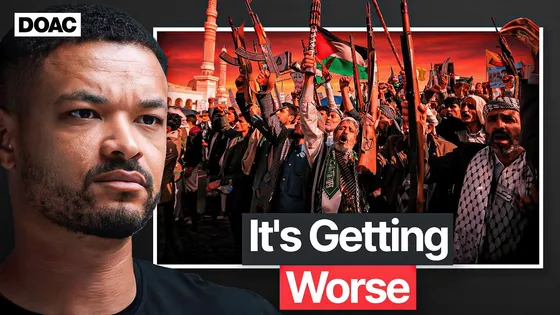
Cenk Uygur says Israel gave America a list of seven countries to attack after 9/11
The Young Turks host turns a Diary of a CEO Iran debate into a blunt accusation about U.S. foreign policy, while Kevin O'Leary argues the real issue is stopping Iran from getting a bomb.
The circuit, read weekly. No noise.