Steven Brunton says insects correct for wind gusts faster than their brains can respond
The applied mathematician’s best point is not that flies are tiny pilots, it’s that they’re tiny control systems with better instincts than our robots.
Listen on YouTube · Spotify · Apple Podcasts
 WATCH NOW↓
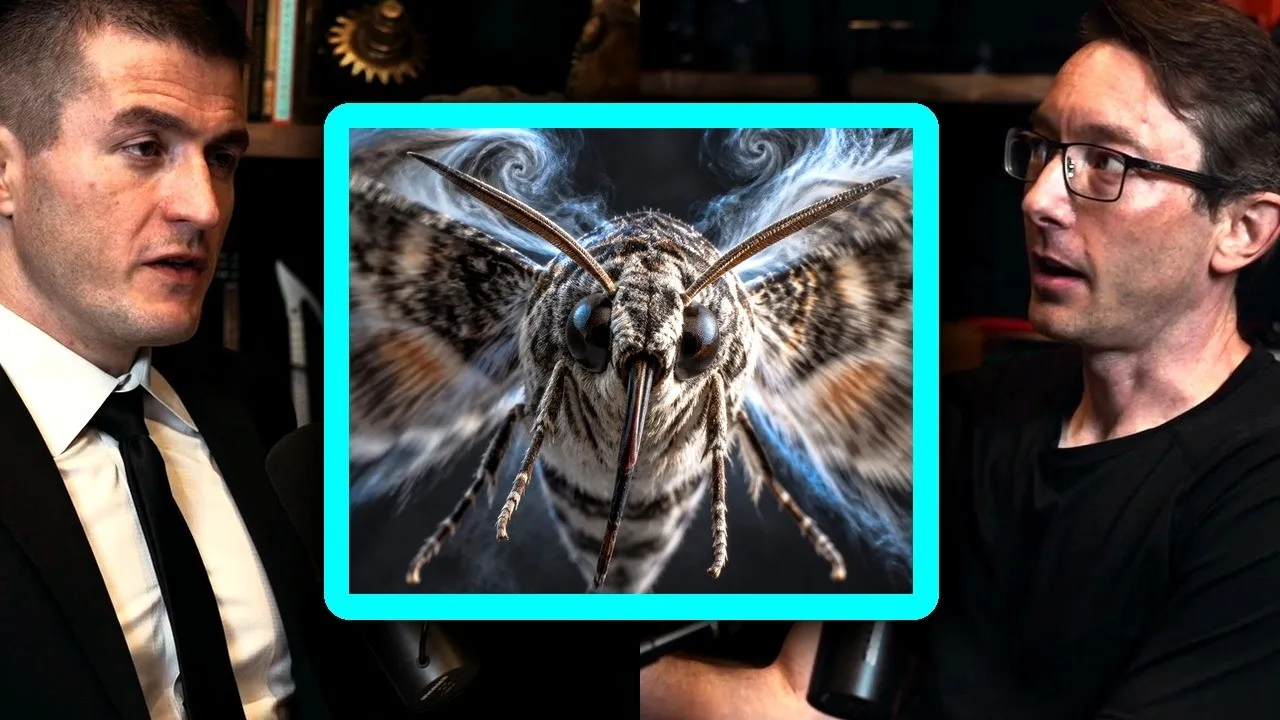
On the Lex Fridman Podcast, Steven Brunton says insects can correct for wind gusts faster than information can travel from their wings to their brains and back to their muscles. He argues that strain-sensitive neurons on the wings and local computation near the shoulder let flies make robust control decisions from partial information. In other words, the fly is not doing a tiny MIT problem set in midair. The fly is cheating beautifully.
That is the useful surprise in this clip. Not the usual TED-ish awe at nature, not the old “birds are amazing” routine, but a specific engineering insult: a bug with a nervous system you could lose in a raisin is still better at certain flight problems than the systems humans build after decades of equations, sensors, and expensive coffee.
they can react to gusts of wind faster than the information that hits their wings, goes to their brain and back to their muscles.
Brunton is talking here as an applied mathematician, not a nature mystic. His frame is fluid dynamics and control: when a system is too complicated to model completely, what is the smallest set of signals that still lets you act well? Weather may require the full mess. A moth in a gust does not have that luxury. It has milliseconds, a body, and some extremely good wiring.
The wing is not just a wing
The key detail is that Brunton does not describe the insect wing as passive hardware waiting for orders from mission control. He describes it as a sensing surface, more like a nervous sail. The gust bends the wing. The wing’s sensors fire. The correction can happen locally.
there are strain-sensitive neurons embedded on the wings, maybe a few dozen to a few hundred of these in very stereotypical locations.
That “stereotypical locations” bit is doing real work. Brunton is not saying every fly improvises jazz with its nervous system. He is saying evolution has baked in a repeatable sensor layout, a tiny distributed control architecture. Brother fruit flies, he says, have the same locations for these neurons. Nature did not merely stumble into flapping. It standardized the parts.
a local computation is happening in that shoulder muscle of this insect that goes directly back and corrects robustly based on partial information of a system it doesn’t have equations for that is nonlinear and turbulent.
This is where the claim is strongest. Brunton’s verdict is not that insects know more than our models. It is that they need less. Their advantage is not omniscience, it is speed plus sufficiency. They do not reconstruct the full flow field, solve Navier-Stokes, and then issue a wingbeat memo. They feel the deformation and adjust.
The robot lesson is humbling
There is a classic engineer’s temptation to make the model bigger until the machine understands the world. Brunton’s insect example points the other way: make the feedback loop smaller until the machine survives the world. That is why insect flight keeps haunting robotics. A fruit fly is not impressive because it is smart in the way a person is smart. It is impressive because it is smart in exactly the place the problem happens.
they presumably don’t have a PhD in fluid dynamics
The grander version of Brunton’s claim, that biological flyers “still dramatically outperform” human-designed fluid systems in many regimes, is mostly fair if we keep the regime small, twitchy, and ugly: gusts, rain, landing, perching, rapid correction under uncertainty. It would be silly to make this into a blanket anti-airplane argument. A moth is not crossing the Pacific with 300 passengers and a beverage cart. But for messy micro-control, the bug has receipts.
If Brunton is right, the future of flying robots may depend less on making them think harder and more on giving them bodies that can feel faster.
- What did Steven Brunton say about insect flight?
- Steven Brunton said insects can react to gusts faster than information can travel from the wing to the brain and back to the muscles. He described wing-embedded strain sensors and local muscle-level computation as a biological shortcut for flying through turbulence.
- Does Steven Brunton think insects understand fluid dynamics?
- No. His point is almost the opposite. Insects do not need equations or full knowledge of the airflow to control themselves. They use fast, local feedback from their bodies, which may be exactly why they remain so robust in messy air.
- Why does this matter for robots and aircraft?
- Brunton is arguing that biological flyers offer a design lesson: control systems can be powerful without measuring everything. For small drones or machines moving through gusts, rain, or turbulent air, copying that kind of partial-information feedback may be more useful than trying to simulate the entire flow field.

Lex Fridman's guest says Navier-Stokes blowups are not black holes in water
The fun part is not that the math might explode, it is that the water probably won't.

Don Lincoln says one gram of antimatter would take a billion years to make at Fermilab's old rate
The Fermilab physicist turned antimatter from Star Trek fuel into a brutal production math problem.

Anthony Kaldellis says Constantinople became a 500,000 person city by importing senators and stealing Rome’s grain
The Byzantine historian’s best point is that Constantinople was not a miracle city. It was an imperial relocation project with free bread and a moving truck full of senatorial servants.

Michael Kofman says Prigozhin had no chance of overthrowing Putin in the Wagner mutiny
The Russia analyst recasts the 2023 march on Moscow as a doomed pressure play, then argues Wagner's real afterlife was inside the Russian army.
The circuit, read weekly. No noise.