Don Lincoln says one gram of antimatter would take a billion years to make at Fermilab's old rate
The Fermilab physicist turned antimatter from Star Trek fuel into a brutal production math problem.
Listen on YouTube · Spotify · Apple Podcasts
 WATCH NOW↓
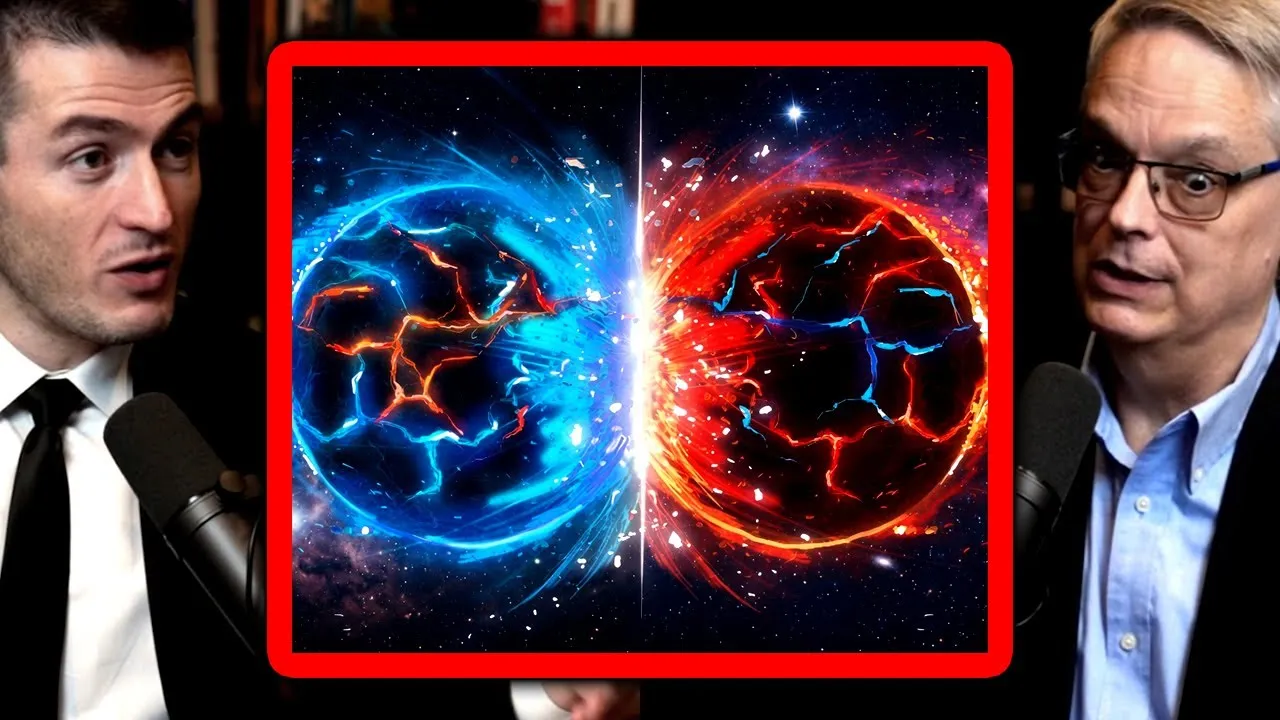
Don Lincoln says on the Lex Fridman Podcast that producing one gram of antimatter at Fermilab’s old antiproton rate would take about a billion years. He also says one gram of antimatter meeting one gram of matter would release energy comparable to the combined Hiroshima and Nagasaki explosions. That is the fun and the buzzkill in one neat package: antimatter is the universe’s most cinematic fuel, and also the worst group project in industrial history.
Don Lincoln, a Fermilab physicist and reliably plainspoken science explainer, is very good at taking the chrome finish off sci-fi ideas. On the Lex Fridman Podcast, Lex wants to talk about antimatter as propulsion, energy source, maybe civilization-level cheat code. Lincoln keeps answering like a man who has seen the invoice.
It’s freaking hard.
That line is doing real work. Lincoln explains that, before 2011, Fermilab was the world’s strongest antiproton factory. Every 2.3 seconds, it smashed about 10 trillion protons into a target and got around 100 million antiprotons back. That sounds heroic until you remember atoms are not sold by the dozen. A gram means roughly 10 to the 23 antiprotons. Fermilab was collecting something like a trillion antiprotons over 12 to 24 hours. Congratulations, you have made less than a science-themed speck of dust.
it would take a billion years running with very little downtime to make a single gram of antimatter.
The Star Trek fuel has a Costco problem
The headline version of antimatter is irresistible. Matter plus antimatter equals annihilation, which equals a ridiculous amount of energy from a tiny amount of stuff. The grown-up version is uglier. You have to create it, collect it, cool it, store it, keep it from touching the container, and somehow do all of that without spending more than the GDP of a continent to make a microscopic stash.
If you combine 1 g of antimatter and one g of matter together the energy release is equivalent to the combined Hiroshima and Nagasaki explosions.
The verdict here is simple: Lincoln’s claim is not anti-antimatter. It is anti-fantasy accounting. The physics is real. CERN has made antihydrogen. The ALPHA experiment has even tested whether antimatter falls up or down, with the answer coming back, boringly and beautifully, down. But antimatter as a near-future bomb, battery, or Alpha Centauri cruise ticket is a different thing. That requires not a clever TED Talk, but a revolution in production and containment.
Lincoln is especially cold on the idea that some undiscovered trick will suddenly make antimatter cheap. His explanation is almost annoyingly clean: to make antimatter, you need concentrated energy at particle scales. Accelerators do that. If someone invents another way to pack enough energy into an absurdly tiny volume, great. Until then, the accelerator is the hammer, and the nail is very, very small.
I would be shocked if there was some like new addition to the theory that made antimatter production easier.
The missing antimatter mystery is still the good part
The episode’s bigger mystery is why there is matter around at all. Standard physics says the early universe should have produced matter and antimatter in equal amounts. Equal amounts should have annihilated each other. No galaxies. No podcasts. No one spending Sunday night Googling whether antimatter bombs are legal.
Lincoln’s version is wonderfully tiny and existentially rude: for every billion antimatter particles, there may have been a billion and one matter particles. The billion pairs vanished. The extra one became everything. You, me, Fermilab, the coffee mug, the whole embarrassing species. Particle physics has a way of making human importance feel both miraculous and clerical.
This is where Lincoln is less dismissive, because the mystery is not an engineering budget problem. It is a real open question in cosmology. He points to baryogenesis, leptogenesis, and neutrino experiments that might reveal a subtle difference between matter and antimatter behavior. Fermilab and a Japanese experiment are racing to measure whether neutrinos and antineutrinos oscillate differently. Lincoln says he’d bet they oscillate the same way, which is exactly the kind of scientist answer that sounds boring until you realize the alternative would rattle the origin story of the universe.
For listeners, the practical stake is clean: don’t confuse energy density with availability. Antimatter is not oil in a harder-to-reach field. It is something we know how to make at a rate that turns human ambition into geological comedy. The spaceship dream doesn’t need a better slogan. It needs a way to manufacture and bottle the most explosive substance imaginable without waiting longer than complex life has existed on Earth.
- What did Don Lincoln say about making antimatter?
- Don Lincoln said that Fermilab, when it was the most powerful antiproton production facility in the world, could make roughly a nanogram of antimatter per year. At that pace, producing a single gram would take about a billion years of near-continuous operation. His point was not that antimatter is impossible, but that the production math is savagely unfavorable.
- Could antimatter be used as a bomb or rocket fuel?
- Lincoln agreed that antimatter has enormous energy density in principle, and that one gram of antimatter annihilating with one gram of matter would release energy on the scale of Hiroshima plus Nagasaki combined. But he framed antimatter propulsion as an engineering nightmare, especially because containment failure would be catastrophic. The physics says yes, the practical world says please stop writing checks.
- Where does Don Lincoln think the missing antimatter went?
- Lincoln said nobody knows why the observable universe contains so much matter and so little antimatter. He described the leading idea as a tiny early-universe imbalance, roughly one extra matter particle for every billion antimatter particles. That leftover sliver is everything we see now.
Don Lincoln says galaxies with no dark matter are strong evidence dark matter is real
The physicist’s best pro dark matter argument is wonderfully backward: the missing stuff looks more real when you can find places where it’s missing.
Don Lincoln says we exist because the early universe had one extra matter particle per billion antimatter particles
The Fermilab physicist framed existence as the leftover scrap from a cosmic matter-antimatter wipeout, then admitted nobody knows what caused the imbalance.

Don Lincoln says he worked roughly 105-hour weeks at Fermilab as a graduate student
The Fermilab physicist turns a brutal grad-school schedule into a test of vocation, not a productivity hack.
Don Lincoln says the Higgs field turned on 10^-12 seconds after the Big Bang and gave particles mass
The Fermilab physicist gives the cleanest possible version of a very weird idea: mass, at least for elementary particles, arrived when the early universe cooled enough for the Higgs field to switch on.
The circuit, read weekly. No noise.