William Noguera says he stayed on death row to get a Joseph Naso confession in a Berkeley cold case
The former San Quentin death row prisoner says his strangest act of accountability was delaying his own transfer so he could finish work on an unsolved murder.
Listen on Nightmare Success · YouTube
 WATCH NOW↓
 William Noguera says he refused to leave death row when his lawyers told him he had won enough in court to get out of there. Why? Because, he says, he still needed to extract a confession from convicted serial killer Joseph Naso in a Berkeley cold case.
That is the line in this episode of Nightmare Success that jumps the fence. Not the prison art, though there is plenty of that. Not the wild car theft anecdote, though breaking into a police impound to steal back a Porsche is not exactly a normal Tuesday. The thing you can actually imagine people arguing about is Noguera’s claim that, after decades on San Quentin’s death row, freedom had to wait because a dead woman still needed a name.
The true crime pitch hiding inside the prison memoir
Noguera’s life story arrives with more hooks than a streaming development meeting. He was 18 when he killed his girlfriend’s mother, a crime he doesn’t excuse here. He says the special circumstance that made him eligible for death was based on a witness who later recanted. He spent more than four decades in prison, became an internationally shown artist, wrote books, and eventually became a central figure in the Oxygen and Peacock series Death Row Confidential: Secrets of a Serial Killer.
This could all tip into redemption-industrial complex syrup. Prison memoirs often come with a tasteful gray palette and a lot of language about becoming whole. Noguera is too abrasive for that. He talks about violence, status, fear, and survival with the confidence of a man who knows exactly what kind of room he used to be able to control. Then he makes the turn: he says the work with serial killers became about victims’ families, not him.
Turns out I find out there was actually 26. That was just his top 10.
That number deserves a raised eyebrow. Naso was convicted of four murders, and Noguera is talking here about what he says he learned from proximity, notes, and long-term manipulation. The episode does not prove the 26. It lets Noguera say it. But the bigger claim is less about the final body count than the method: Noguera says he spent years psychologically isolating Naso, asking the same questions across time, checking consistency like a human lie detector with a prison address.
The freedom delay is the whole thing
Noguera says that in 2022, after a partial court win, his attorney told him they could get him off death row. His answer, if true, is absurd in the most literal sense. The door cracked open, and he said not yet.
No, absolutely not.
He says his lawyers thought he had lost it. Fair. If your client has spent roughly 40 years under a death sentence and responds to escape with the vibe of someone finishing one more email before vacation, you do not simply nod and update the calendar.
I hadn’t extracted the confession for a particular homicide. It was the girl from Berkeley.
The episode’s cleanest factual chain is this: Noguera says he got the information, contacted cold case investigator Ken Mains, and Mains came back fast with an identification. Noguera gives the victim’s name as Miss Colms. The show doesn’t slow down to litigate the files, which is frustrating, because this is exactly where a podcast should stop polishing the legend and start pinning documents to the wall.
Still, as a piece of audio, the claim has weight because Noguera attaches it to risk. He says crossing over into the serial killer yard was a prison violation in the informal law of the place, that a previous permission structure disappeared, and that an order was put out on him. Again, this is his telling. It is also, unmistakably, the kind of telling that true crime television eats with both hands.
Living amends, with a camera crew waiting
Noguera is a complicated narrator because he knows the power of his own story. He knows the beats. The condemned teenager. The cell turned studio. The serial killer whisperer. Dick Wolf’s name floating into frame like the Law & Order chung-chung made flesh. That doesn’t make him wrong. It does mean the listener should keep one hand on the emergency brake.
His best line is also his most revealing. He doesn’t frame the cold case work as absolution. He frames it as a payment plan on a debt that cannot be zeroed out.
I had done something for a victim’s family. And it was just an inch in the right direction of saying I’m sorry. It was a living amends.
- What cold case does William Noguera say he was working on?
- Noguera says he was trying to get information from Joseph Naso about a homicide involving “the girl from Berkeley.” He says that after he got the confession, he contacted Ken Mains, who identified the woman as Miss Colms within 48 hours.
- Why would Noguera stay on death row longer?
- His explanation is that he saw the work as a form of living amends, not as a legal bargaining chip. He says he had no expectation of getting out and wanted to give a victim's family some kind of answer.
- Should listeners take Noguera's claim as proven?
- The episode gives Noguera's version, not a case file. It is specific enough to matter, and it names Joseph Naso, Ken Mains, and a Berkeley victim, but the show relies on Noguera's telling rather than independently walking the listener through documentary proof.
Ryan Moser says he published more than 250 pieces during a 10-year prison sentence
The Nightmare Success intro sells Moser’s prison-to-newsroom story with one unusually concrete number, and it is the rare redemption-podcast detail that actually deserves a second look.
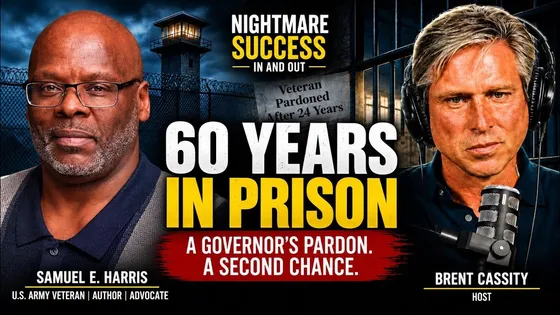
Samuel E. Harris says he wrote 1,084 prison letters before Governor Glenn Youngkin pardoned him
On Nightmare Success, Harris describes clemency less as a miracle than as a paperwork siege, after a 220-year sentence and 24 years behind bars.
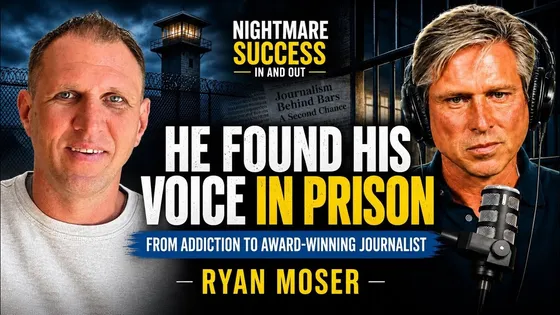
Ryan Moser says prison journalism let him leave prison with $10,000 and a career
The former incarcerated writer tells Nightmare Success that bylines, mentors, and paid prison journalism gave him a reentry plan most people never get.

Jennifer Michele Helm says she found out she was federally indicted by email after smoking a joint in Laguna Beach
The former luxury interior designer describes federal fraud charges arriving not as a dramatic knock at the door, but as an email interrupting a very California morning.
The circuit, read weekly. No noise.