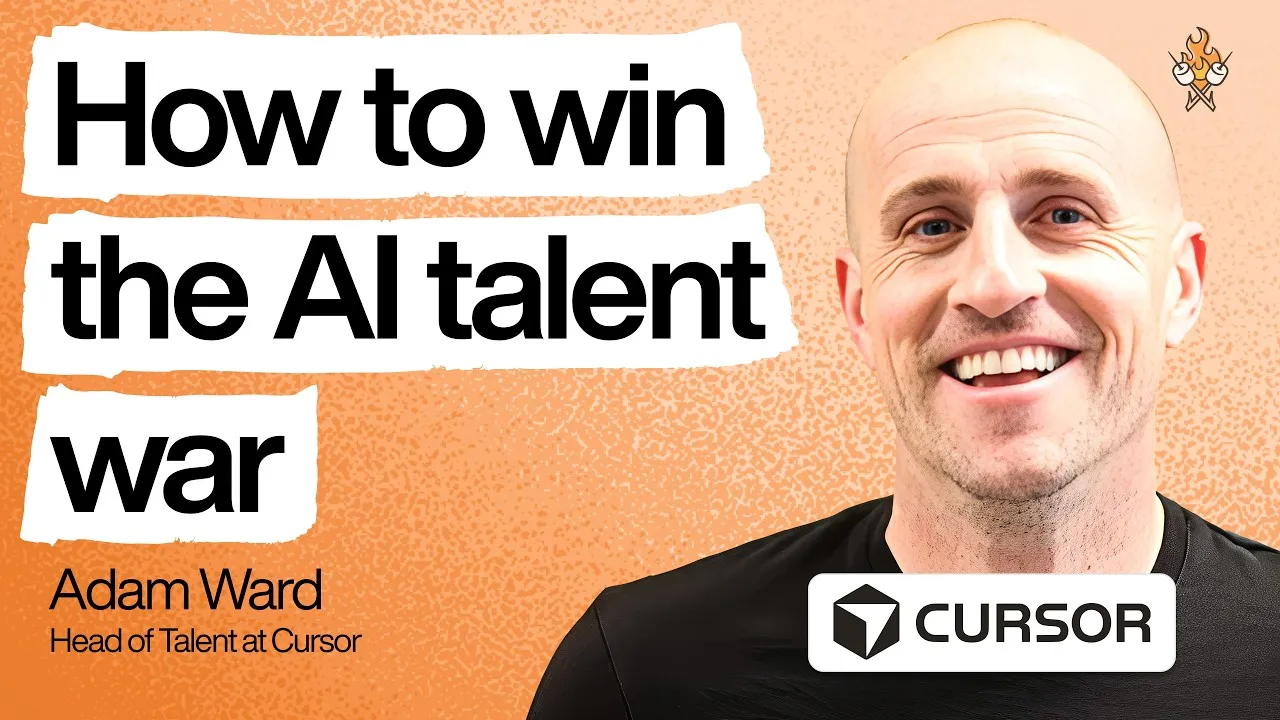
Adam Ward says asking 'who's the best product engineer you know?' is the worst recruiting question
The Cursor head of talent argues that most companies hire from a 'funnel of doom' and end up with whoever was available, not whoever was best.
Listen on YouTube
 WATCH NOW↓
 The most useful recruiting advice in Adam Ward’s appearance on Lenny’s Podcast is also the most annoying, because it indicts a question every founder has asked while pretending to be strategic: “Who’s the best product engineer you know?” Ward, now head of talent at Cursor, says that is “the worst question you can ask.”
His replacement question is less sexy and much more dangerous to your calendar. Don’t ask for the best person. Ask for the person who is best at the exact thing your team needs, the engineer who collaborates with designers, the PM who can turn a framework into a product, the operator who can reduce chaos without becoming a human Jira board. In Ward’s world, recruiting isn’t a net you drag through LinkedIn. It is a manhunt with manners.
The mistake that most companies make is they’ll say, “Hey Lenny, who’s the best product engineer you know?” That is the worst question you can ask.
Ward has the résumé to make founders sit up a little straighter. He helped scale Facebook’s tech org, led global recruiting at Pinterest, co-founded Growth by Design, then joined Cursor after the company acquired the whole firm. That last bit is the giveaway. In the current AI hiring market, talent isn’t HR wallpaper. It is infrastructure. Cursor didn’t just want recruiters. It wanted the machinery.
The funnel is the enemy
Ward’s big villain is what he calls the “funnel of doom,” the standard process where a company reaches out to 100 people, gets 20 replies, screens them down, and hires the survivor. It feels scientific because there are stages and percentages. It is also, in his telling, fake rigor with a dashboard.
By definition that is not the top 20% that is just the 20 people who you caught on a bad day for them. Good day for you, bad day for them.
This is the kind of sentence that should be printed and taped to the monitor of anyone who says recruiting is just sales. Ward’s point is brutally simple. A candidate responding to your cold email is not evidence they are among the best. It is evidence that your message arrived during a wobble, a bad manager week, a compensation irritation, a commute rage spiral. Congratulations, you found availability.
His alternative is executive search applied to ordinary-seeming roles. Define what great means before meeting candidates. Map the market. Find the 50 people in the world who could actually do the job. Then go after them with the persistence of a prestige college football program and the emotional calibration of a good dinner host.
there are 50 people in the world who can do this. Let’s go find those 50 people.
The verdict: Ward is right about the disease, even if the cure is not cheap. Most companies do use process as a substitute for taste. They inherit interview loops, worship logos, and call it discipline. But Ward’s method requires founders and hiring managers to spend time they usually claim not to have. If talent is truly number one, his answer is obvious. If talent is merely number one in the all-hands deck, the funnel survives.
Specificity beats status
The sneakiest part of Ward’s argument is that he is not telling founders to chase bigger logos. In fact, he warns against that. A person from a famous team might be great, or might have been standing near greatness wearing the hoodie. The better move is to describe the work, the values, the taste, the collaboration style, then ask trusted people who matches those signals.
That matters because the AI labor market has made generic prestige even less useful. Ward describes an 11-out-of-10 hiring market where forward deployed engineers are suddenly scarce, specialized technical workers may be less prized, and AI researchers are fielding cartoonish offers. In that market, asking “who’s best?” is not just lazy. It is too slow.
The funny thing is that Ward’s supposedly modern playbook sounds almost pre-industrial. Sit with employees. Dig through their networks. Ask follow-up questions. Invite candidates for coffee. Feed them. Create daily stand-ups around high-priority closes. Buy a candidate who loves stringed instruments a weird Turkish guitar-like gift before handing over the offer. Somewhere, an ATS just fainted.
we can care more about that candidate than anyone else. That That’s in us. That’s within us. We can do that.
There is some self-interest here. Ward is a recruiting leader arguing that recruiting should be treated like a core company function and, later, that recruiting teams should be among the highest paid teams in the company. Shocking development, the recruiting guy believes recruiting is underpriced. But he makes the case cleanly: recruiters at this level are not résumé traffic cops. They are, as he puts it, a “confidence engine” for hiring managers.
The real stake for startups is uncomfortable. If Ward is right, your hiring problem may not be that the market is too competitive, or that Anthropic has more money, or that candidates are flaky. It may be that you are asking mushy questions, getting mushy names, and calling the mush a pipeline.
- Why does Adam Ward think 'who's the best product engineer you know?' is a bad recruiting question?
- Ward's point is that the question is too broad to produce useful signal. People don't retrieve names from memory as a ranked global leaderboard. They remember specific behaviors, like the engineer who collaborates unusually well with designers or turns frameworks into products. Better inputs produce better names.
- What does Adam Ward mean by the 'funnel of doom'?
- He means the standard recruiting funnel where companies contact a large pool, screen out people in stages, and hire whoever remains. Ward argues that this doesn't identify the best candidates, it identifies the people who happened to reply and survive the process.
- Does Ward's recruiting playbook work for every company?
- Not really. It is persuasive for companies chasing scarce, high-impact talent, especially in AI, but it is expensive in time and attention. The playbook only makes sense if a founder truly believes talent is the top priority and is willing to behave like it.
Anish Acharya says most AI companion users are women in their 40s and 50s
The a16z consumer investor punctured the AI girlfriend cliché and argued that consumer AI's real prize is not productivity, it is emotional need.
Ian Silber says AI is already an incredible product designer
OpenAI’s head of product design makes the case that designers aren’t doomed by AI, they’re late to the most useful tool in the room.
Elizabeth Stone says Netflix needs fewer narrow specialists and more systems thinkers in the AI era
Netflix’s CPTO argues that AI makes cross-functional judgment more valuable than one-lane expertise, though she’s not ready to throw engineering, design, or data science craft into the volcano.
Noam Segal says tech workers fear doing more for the same pay more than losing their jobs to AI
The AI job panic has been sold as a robot replacement story, but Segal's survey says the more immediate fear is much more office Slack: congratulations, your output just became your new quota.
The circuit, read weekly. No noise.