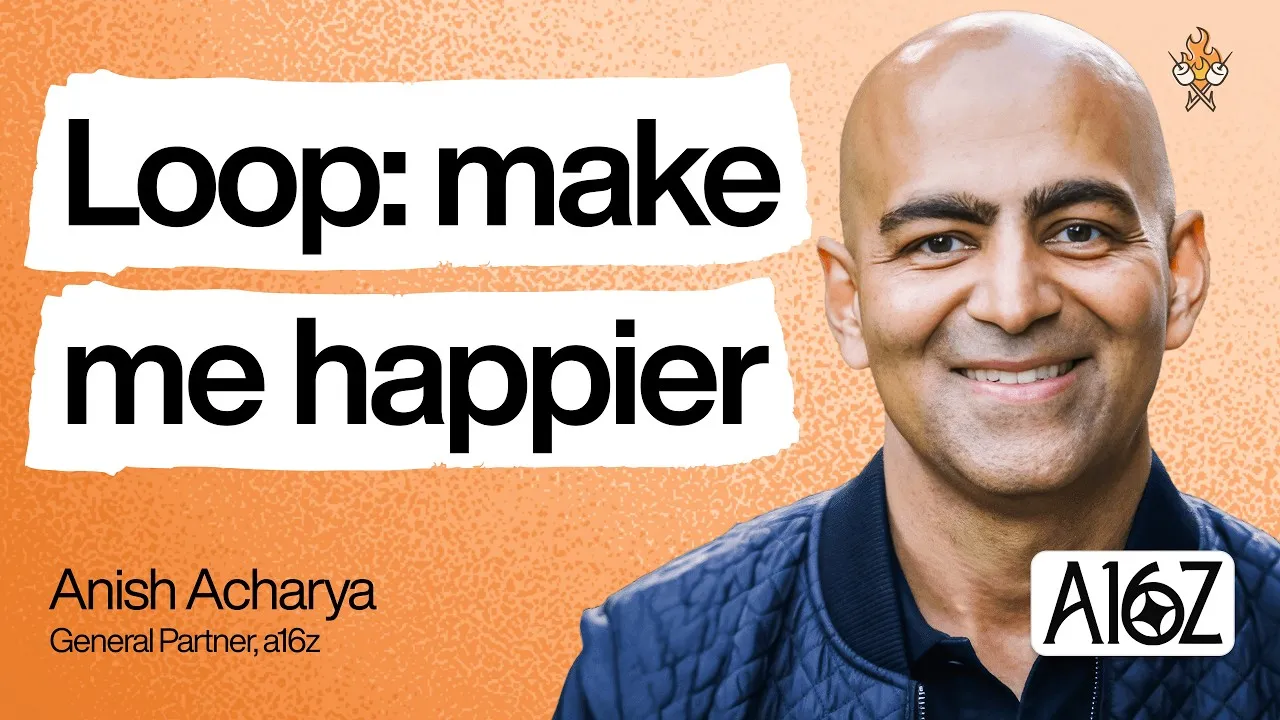
Anish Acharya says most AI companion users are women in their 40s and 50s
The a16z consumer investor punctured the AI girlfriend cliché and argued that consumer AI's real prize is not productivity, it is emotional need.
Listen on YouTube
 WATCH NOW↓
 The AI girlfriend cliché has always had the subtlety of a crypto billboard, young men, dark bedrooms, anime avatars, society collapsing one push notification at a time. Anish Acharya, the a16z consumer investor, says the actual companion AI audience is more surprising: mostly women in their 40s and 50s.
That is the kind of claim that makes a whole category snap into focus. On Lenny’s Podcast, Acharya was talking about where consumer AI is going, and for a moment the usual Silicon Valley vocabulary, agents, loops, frontier models, growth, dissolved into something more human and less board-deck friendly. Maybe the killer app isn’t making your spreadsheet smarter. Maybe it is making Thursday night less lonely.
Though though actually to be accurate is more boyfriends and girlfriends actually, you know. Um the majority of people using companion products are women that are in their 40s and 50s actually.
There are two ways to hear this. The boring way is as a market-map correction, fine, duly filed under user demographics. The better way is as a warning that the people joking about AI companions may not understand the job the product is doing. If the users are middle-aged women, the category starts looking less like a punchline about digital girlfriends and more like a giant, uncomfortable consumer need hiding in plain sight.
The productivity story is too small
Acharya’s larger complaint is that AI has been sold to consumers like a boss with a stopwatch. Save time. Crush tasks. Become an efficiency goblin with six browser tabs and a subscription problem. He thinks that misses what most normal people want from technology.
we believe that people want to be more productive, but they don’t. I think more people want to spend time than save time.
This is both obviously true and somehow still illegal to say in founder circles. Most people do not wake up craving a better way to summarize PDFs. They want to laugh, flirt, be seen, learn something, make something, stop feeling like their life is mostly logistics. That is why the largest consumer apps tend to be social or entertaining, not productivity dashboards wearing a Patagonia vest.
Acharya calls the opportunity something like a happiness loop, which sounds dangerously close to a wellness startup with a sand-colored landing page, but his point is sharper than the phrase. Consumer AI has the technical capability to respond, remember, generate, nudge, challenge, and entertain. The missing piece is product taste, not another IQ point on a benchmark.
How do we feel more connected, more loved? How do we make progress? How do we have fun?
The cringe is the signal
The companion category is hard to discuss because everyone wants to sound like the last sane person at the dinner table. AI boyfriends, AI girlfriends, emotionally reactive bots, synthetic intimacy, these are phrases that practically arrive wearing a hazmat suit. Acharya’s point is that this discomfort is exactly why startups may have room to build. Big companies are allergic to weirdness. Consumer behavior is made of weirdness.
there’s a way that AI can sort of challenge you, can push you, can be disagreeable.
That line matters because companionship products cannot just be nicer search boxes with better eyelashes. A companion that only flatters you is a slot machine with pet names. A companion that can push back, remember context, create rituals, and offer some emotional friction starts to become a product people might actually live with.
Now, the caveat: Acharya does not present a dataset in the transcript. He is an investor with privileged pattern recognition, not a census bureau in Allbirds. Treat the women-in-their-40s-and-50s claim as a serious market read, not settled public fact. Still, it is more interesting than the lazy story. It also fits the bigger cultural picture: loneliness is not confined to teenage boys with Discord handles, and desire for attention does not politely vanish at 39.
The bet hiding underneath Acharya’s claim is that AI companions will not win by pretending to be productivity tools. They will win if they can make people feel something reliably enough to become habit. That is thrilling, creepy, lucrative, and probably inevitable. If the category really belongs to women in midlife as much as or more than young men, the next Reddit argument should not be whether AI companions are pathetic. It should be who they are already replacing.
- What did Anish Acharya say about AI companion users?
- He said the category is more accurately described as AI boyfriends and girlfriends, and that most people using companion products are women in their 40s and 50s. That cuts against the usual internet caricature of AI companions as a young male obsession.
- Why does that claim matter?
- It changes the business story. If AI companions are serving middle-aged women at scale, the category is not just novelty, roleplay, or cringe content for screenshots. It may be addressing a much bigger consumer need around connection, attention, affection, and emotional routine.
- Was Acharya saying AI companions are the main future of consumer AI?
- Not exactly. He grouped companionship with entertainment and creative tools as one of three big consumer AI areas, alongside coding agents and personal agents. His broader argument is that consumer AI has been too trapped in productivity, while the bigger prize is making people feel happier, more connected, and more alive.
Ian Silber says AI is already an incredible product designer
OpenAI’s head of product design makes the case that designers aren’t doomed by AI, they’re late to the most useful tool in the room.
Adam Ward says asking 'who's the best product engineer you know?' is the worst recruiting question
The Cursor head of talent argues that most companies hire from a 'funnel of doom' and end up with whoever was available, not whoever was best.
Elizabeth Stone says Netflix needs fewer narrow specialists and more systems thinkers in the AI era
Netflix’s CPTO argues that AI makes cross-functional judgment more valuable than one-lane expertise, though she’s not ready to throw engineering, design, or data science craft into the volcano.
Noam Segal says tech workers fear doing more for the same pay more than losing their jobs to AI
The AI job panic has been sold as a robot replacement story, but Segal's survey says the more immediate fear is much more office Slack: congratulations, your output just became your new quota.
The circuit, read weekly. No noise.