Elizabeth Stone says Netflix needs fewer narrow specialists and more systems thinkers in the AI era
Netflix’s CPTO argues that AI makes cross-functional judgment more valuable than one-lane expertise, though she’s not ready to throw engineering, design, or data science craft into the volcano.
Listen on YouTube
 WATCH NOW↓
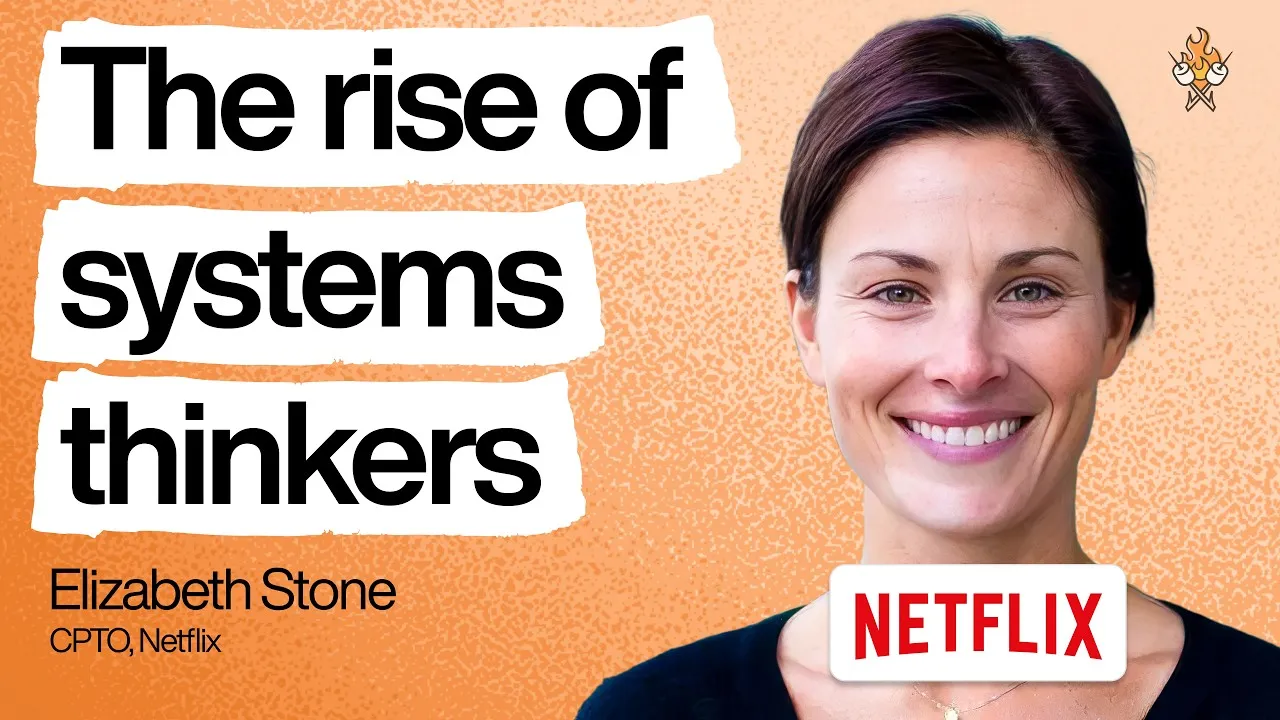
 Elizabeth Stone, Netflix’s chief product and technology officer, says the company now needs more systems thinkers and fewer narrow specialists because of AI. That is the cleanest job-market signal in her return to Lenny’s Podcast: the safest career move is no longer becoming the one human alive who understands one tool, one stack, or one workflow.
This is not the usual AI pep talk where everyone becomes a founder, a coder, a designer, a prompt poet, and, somehow, a better hydrated person. Stone’s point is colder and more useful. AI creates more motion inside a company like Netflix, which means the winners are people who can reason across systems: infrastructure, source-of-truth data, design language, agents, security, and the business problem the feature was supposed to solve before six prototypes showed up in Slack wearing a fake mustache.
We need more systems thinkers in a world with AI.
The unsexy word here is infrastructure. Stone says Netflix historically let local teams move fast, often without forcing them onto a central paved path. That worked when the work was more contained. In an AI world, with agents operating across systems and more people doing more kinds of work, the company needs common building blocks, clearer guardrails, and fewer Frankenstein product experiences stitched together by enthusiasm and Copilot.
The specialist era is shrinking, not dead
Stone is careful not to declare a funeral for expertise. She says great engineering is still scarce, great data science is still scarce, and great creativity is still scarce. Good. Because the alternative, a company run entirely by generalists with vibes and admin access, sounds less like the future of work than the first act of a cybersecurity training video.
The days of very narrow, deep specialization feel more limited to me.
Her distinction matters. Netflix still needs deep experts in things like encoding, playback, and other technical corners where only a few people know how the machinery really works. But Stone is skeptical of the specialist who treats a domain like a bunker. A payments expert, an ads marketplace expert, or a front-end engineer can still be valuable, but only if they are willing to ask whether the old tool, old architecture, or old process still makes sense.
That is the part that makes this more than corporate competency Bingo. Stone is describing a real shift in status. In the pre-GenAI company, the person with the most local knowledge often had the power. In the AI company, local knowledge decays faster. The valuable person can learn the local thing, connect it to the larger system, and then leave the system better than they found it.
Netflix’s AI answer is guardrails, not chaos
Stone’s most revealing tension is that Netflix still wants its famous high-agency culture, the culture-deck stuff every startup founder has quoted while ordering Herman Miller chairs, but AI is forcing a little more centralization. She does not call it process. Of course not. At Netflix, process is the carbs of management. But preferred paved paths, source-of-truth data, and guardrails are process-adjacent enough to make the point.
the most useful thing is not to make it level specific or role specific, but to encourage everyone towards the expectation on AI fluency
That AI fluency overlay is the practical takeaway. Netflix is not, according to Stone, rewriting every career ladder by quarter like a cursed Google Doc. It is telling everyone, senior leaders included, that they need judgment about artificial intelligence: where to use it, where not to use it, how to test it, and how to remain accountable when an agent wrote the thing that just broke.
The best contradiction came when Lenny invoked Jenny Wen and the “design process is dead” thesis. Stone did not bite. She agrees AI speeds up design work, but she rejects the idea that design thinking gets squeezed out because someone can generate more code faster. For a company that sells ease, taste, and invisible complexity, that would be self-harm with a productivity dashboard.
I think it would be a mistake to say design and deep design expertise and thinking gets squeezed out just because we can write code faster.
Stone’s claim is convincing, with one asterisk. It is also very convenient for Netflix. “Systems thinker” is exactly the kind of phrase a high-talent-density company loves because it flatters the person being hired and raises the bar for everyone else. Still, the logic holds. If AI lets more people build more things faster, the scarce skill becomes deciding which things should exist, how they fit together, and what happens when the machine gets weird.
So if you are trying to read the job market tea leaves, do not hear Stone saying craft is over. Hear the harsher thing: craft alone is no longer enough. The next version of the Netflix employee can still go deep, but they also have to zoom out one click, see the system, and stop shipping Frankensteins.
- Is Netflix really hiring fewer specialists because of AI?
- Stone says the direction is fewer people who stay inside a narrow specialty and more people who can adapt across domains. She does carve out exceptions for rare technical areas like encoding and playback, where deep expertise still matters. The target is not the end of specialists, it is the end of specialists who refuse to zoom out.
- What does AI fluency mean at Netflix?
- Netflix is treating AI fluency as an expectation across roles rather than a neat line on every career ladder. Stone describes it as judgment about where AI is useful, comfort experimenting with new tools, and accountability for the output. In other words, using AI is not enough. Knowing when not to trust it is part of the job.
- Does Elizabeth Stone think AI makes designers and engineers obsolete?
- No. Stone says AI lets PMs, designers, and data scientists move further before engineering has to take over, but she repeatedly argues that craft still matters. Her line is that teams may blur, but great engineering, data science, and creativity are still scarce.
Emmanuel Ameisen says Claude can make hidden plans before it writes
The Anthropic interpretability researcher says the “next token” machine sometimes carries a backstage plan, which is not consciousness, but is also not your iPhone autocomplete.
Josh Woodward says corporate labs usually fade after three to four years
The Google Labs VP argues that every company now needs a frontier AI team, but history says those teams usually turn into expensive petting zoos for prototypes.
Anish Acharya says most AI companion users are women in their 40s and 50s
The a16z consumer investor punctured the AI girlfriend cliché and argued that consumer AI's real prize is not productivity, it is emotional need.
Ian Silber says AI is already an incredible product designer
OpenAI’s head of product design makes the case that designers aren’t doomed by AI, they’re late to the most useful tool in the room.
The circuit, read weekly. No noise.