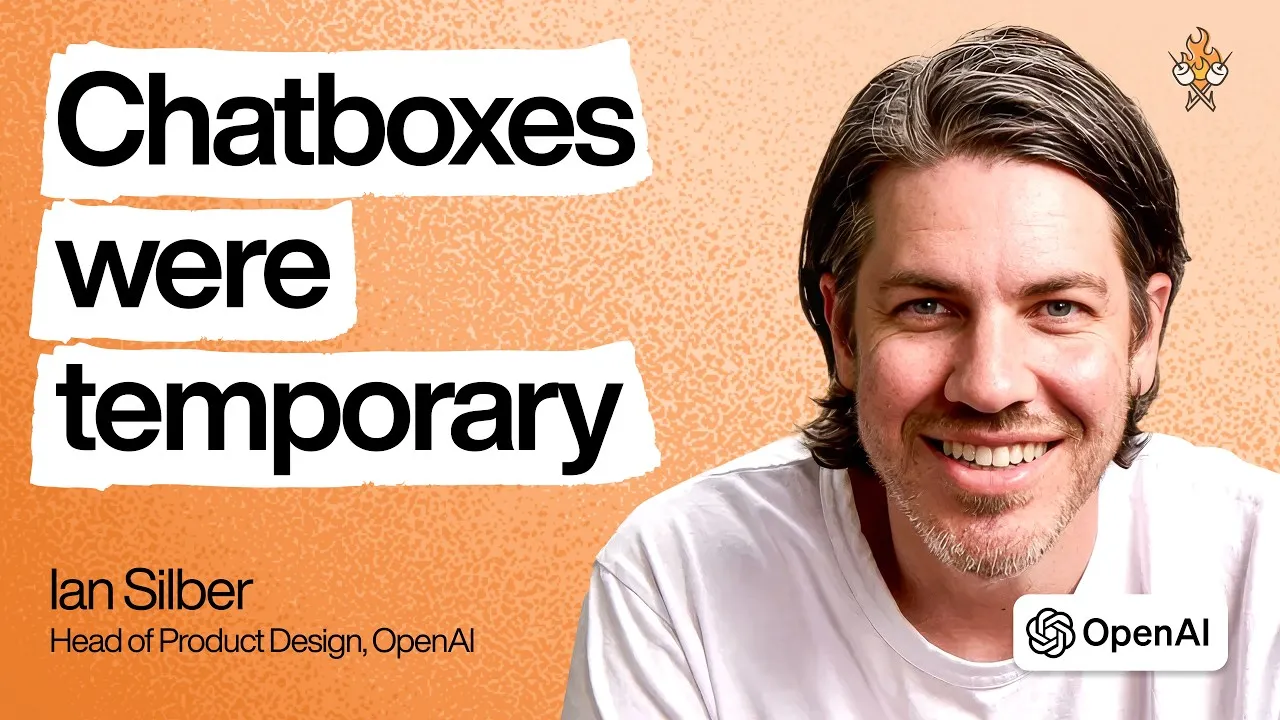
Ian Silber says AI is already an incredible product designer
OpenAI’s head of product design makes the case that designers aren’t doomed by AI, they’re late to the most useful tool in the room.
Listen on YouTube
 WATCH NOW↓
 A head of design saying AI is already an incredible product designer is either radical honesty or the cleanest sales pitch in the building. On Lenny’s Podcast, Ian Silber, OpenAI’s head of product design, chose the dangerous version anyway: AI is not waiting to become good at product design. In his telling, it’s already there.
I think it already is an incredible um product designer.
That sentence lands like a coffee cup dropped in a design critique. Silber is not a random LinkedIn futurist typing “adapt or die” over a sunset photo. He runs design at OpenAI, after years at Instagram and a stint at Artifact, which means he is both unusually close to the tools and unusually incentivized to make them sound magical. The honest verdict: his claim is true if “product designer” means tireless prototyping partner, pattern recognizer, and idea generator. It’s exaggerated if it means a fully formed taste machine that understands people better than people do.
Designers are miserable, and Silber thinks he knows why
Lenny Rachitsky came in with a bleak little weather report from tech: designers and user researchers, in his workforce sentiment survey, are apparently the saddest kids at the offsite. Most overwhelmed, most anxious, least optimistic, least likely to recommend the job. Very “Figma file titled final_final_v7, but spiritually.”
Silber’s diagnosis is not that designers are soft or obsolete. It’s that the job description has gone blurry. Engineers got coding agents and a scoreboard. Designers got vibes, uncertainty, and the haunting suspicion that they’re supposed to be shipping production code before lunch.
you know engineers have 10 or sometimes like 100x their productivity uh but our design team hasn’t right because the design process still takes time.
This is the part Silber gets exactly right. Engineering has found a very clean AI story: type request, get code, fix bug, repeat. Design is messier because the hard part is often not making the thing. It’s knowing whether the thing should exist, whether people will understand it, whether the interaction feels inevitable or like a smart fridge asking for a firmware update.
nobody should feel like behind right now. I think that if you literally started today, you’re going to have a leg up on pretty much most people.
That is the most comforting line in the episode, and also the most suspiciously convenient. Nobody at OpenAI wants designers to conclude that AI tools are hostile territory. But Silber’s broader point is stronger than the corporate optimism around it: the process is changing so fast that expertise from six months ago can already smell like old milk. If you were waiting for the perfect tutorial, congratulations, you’re now behind the person who opened Codex on their phone and made something ugly.
The human job is moving from making to choosing
Silber is careful not to claim that ChatGPT is secretly Dieter Rams with a context window. He says AI is not necessarily the best visual designer, the best typography brain, or the best interaction designer. Instead, he treats it as a force multiplier for the early mush of design: sketching, prototyping, exploring, breaking assumptions, getting from “what if?” to “oh no” faster.
His bigger argument is that the human advantage is shifting toward taste, intent, and empathy. Humans still watch someone use a thing and feel the tiny cringe when the interface asks too much. Humans still notice that the new interaction paradigm is not in the training data. Silber points to the iPhone, Instagram, and Snapchat as examples of great design that didn’t just remix what already existed, but understood a new behavior before it became obvious.
Inside OpenAI, that seems to mean two speeds at once. Some features get the old sweat, test, throw away, refine treatment. Others get shipped fast, publicly, almost experimentally. Silber described a world where some ideas can go from conception to shipping in hours, while more durable changes to ChatGPT’s role in a person’s life still get whiteboards, prototypes, dogfooding, and caution.
don’t design it if you don’t have to.
That may be the most quietly brutal design advice in the whole conversation. Not “make it delightful.” Not “sweat the pixels.” Just: maybe stop adding stuff. In an AI product that can sprout features like kudzu, restraint becomes a design skill. Systems thinking, reusable primitives, fewer one-off experiences, less preciousness. Glamorous? No. Useful? Annoyingly, yes.
The contradiction is the point
There’s a nice tension here with a recent Lenny conversation Rachitsky mentions with the PM of Codex, who argued that AI still struggles at design because great design often means doing something new. Silber doesn’t really refute that. He absorbs it. AI is already an incredible designer, he says, but the most valuable human work is still understanding unmet needs, forming a point of view, and deciding what good is.
So yes, the claim is self-serving. Of course the OpenAI design chief thinks the OpenAI-shaped future is good for designers. But he’s not selling the laziest apocalypse. He’s selling a stranger deal: more people can make software, which means the average product may get louder, faster, and more samey, while actual taste becomes more valuable.
If Silber is right, the safest designer is not the one guarding the old process like it’s a rent-controlled apartment. It’s the one who can ask a sharper question, spin up five bad prototypes, and kill four of them without making it a personality crisis. The new status symbol is not the perfect mockup. It’s the taste to delete 99 of them.
- Did Ian Silber say AI is going to replace product designers?
- Not exactly. Silber said AI is already an incredible product designer, but he framed it as a tool that gives humans more creative range, not as a pink slip in chatbot form. His line is still provocative because product design is supposed to be the human job, the taste job, the empathy job. His answer is basically: yes, AI can design, but humans still decide what is worth designing.
- Why does Ian Silber think designers are so anxious right now?
- He thinks the role has lost clarity. Engineers can point to coding agents and say their output has jumped, while designers still have to live through the slow, annoying, necessary cycle of trying ideas, hating them, testing them, and throwing most away. That mismatch makes designers feel behind, even when the work itself still demands human judgment.
- What advice did Ian Silber give designers worried about AI?
- His advice was to start immediately and stop treating AI fluency like a secret club that already closed membership. Silber argued that the field is early enough that someone beginning today can still get ahead of most people. The practical version is less mystical: prototype more, test weirder ideas faster, and stop worshipping the old process when the output is what matters.
Anish Acharya says most AI companion users are women in their 40s and 50s
The a16z consumer investor punctured the AI girlfriend cliché and argued that consumer AI's real prize is not productivity, it is emotional need.
Adam Ward says asking 'who's the best product engineer you know?' is the worst recruiting question
The Cursor head of talent argues that most companies hire from a 'funnel of doom' and end up with whoever was available, not whoever was best.
Elizabeth Stone says Netflix needs fewer narrow specialists and more systems thinkers in the AI era
Netflix’s CPTO argues that AI makes cross-functional judgment more valuable than one-lane expertise, though she’s not ready to throw engineering, design, or data science craft into the volcano.
Noam Segal says tech workers fear doing more for the same pay more than losing their jobs to AI
The AI job panic has been sold as a robot replacement story, but Segal's survey says the more immediate fear is much more office Slack: congratulations, your output just became your new quota.
The circuit, read weekly. No noise.