Arthur Brooks says trying to avoid unhappiness makes you miss happiness
On Huberman Lab, Brooks argues that happiness is built from enjoyment, satisfaction, and meaning, and none of the three comes pain-free.
Listen on YouTube · Spotify · Apple Podcasts
 WATCH NOW↓
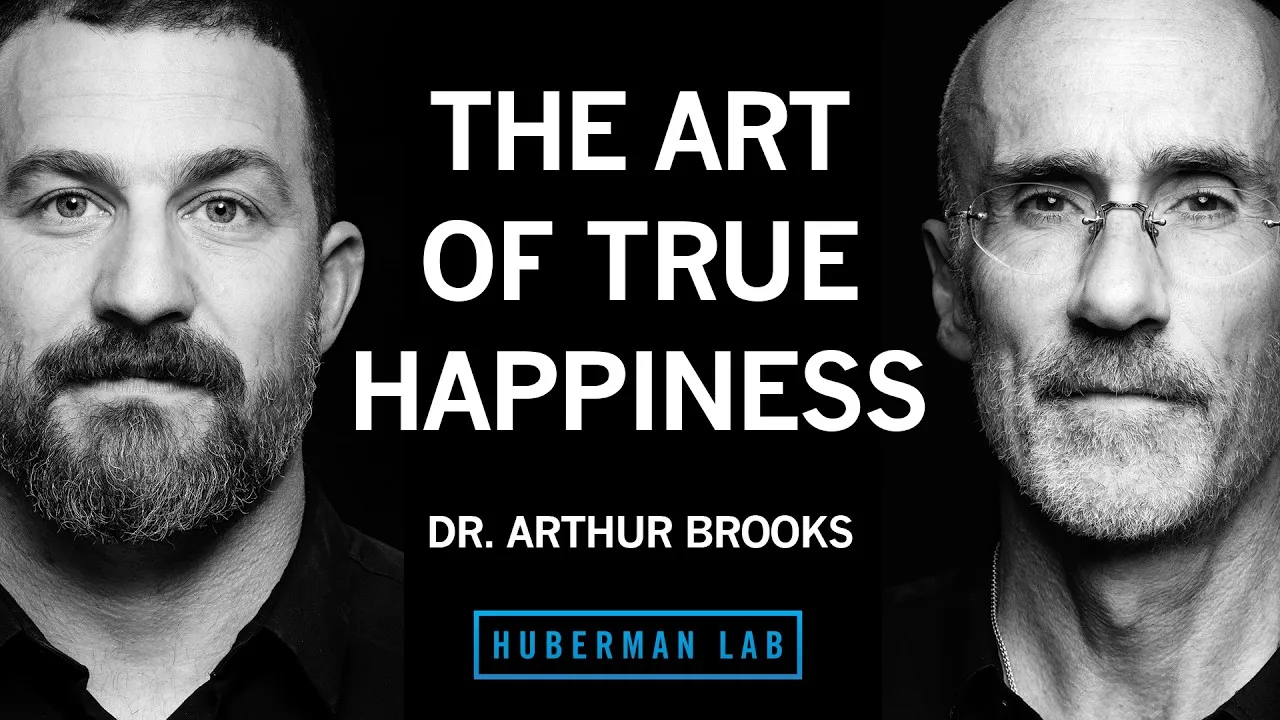
 Arthur Brooks has a tidy little grenade for the wellness crowd: if your plan is to delete unhappiness from your life, congratulations, you may also delete the happiness. On Huberman Lab, Brooks tells Andrew Huberman that the good life is not a spa menu with better sleep scores. It is enjoyment, satisfaction, and meaning, each one with some ache folded inside like a hotel fee you only see at checkout.
There are three macronutrients to the happiest life. The happiest people have enjoyment, satisfaction, and meaning. Those are the three macronutrients.
That is the clean, searchable Brooksism here, and it is why Arthur Brooks works so well on a show that usually sounds like it was engineered inside a very expensive water bottle. Huberman brings the dopamine vocabulary. Brooks brings Aristotle, Catholic practice, marriage vows, leg day, and a faintly alarming willingness to call his own weaknesses by name. The result is not a recap of happiness research. It is a fight over what we even mean when we say we want to feel good.
The pleasure trap has a punchline
I mean, the pursuit of pleasure is not the secret to happiness. It’s the secret to rehab, right?
That line is funny because it is rude in the way a good diagnostic can be rude. Brooks is not saying pleasure is evil. He is saying pleasure, left alone in a room with your limbic system, starts making bad decisions. Enjoyment, in his telling, is pleasure that has been civilized. Add people. Add memory. Add the version of yourself you would not be embarrassed to watch on security footage.
This is where the episode becomes more useful than the usual cold shower catechism. Brooks is speaking to strivers, which is to say, much of the happiness internet and nearly all of Huberman’s audience. He knows the pathology: people who can delay gratification forever, then forget what the marshmallow was supposed to be. His warning is not anti-discipline. It is anti-scoreboard. If your life is all earning and no receiving, you have not mastered desire. You have just put it in a blazer.
If you spend your life, which many people do today trying to avoid unhappiness, trying to avoid and eliminate suffering, they will paradoxically miss their own happiness.
He is right, but don’t turn pain into a hobby
The claim is strong, with a caveat the motivational-industrial complex loves to misplace. Brooks is right that avoidance can shrink a life. Anyone who has ever dodged a hard conversation, skipped a meaningful risk, or confused peace with sedation knows the bill comes due. Marriage vows are basically a legally catered admission that things will get ugly. Training hurts. Parenting hurts. Grief is love with its skin off.
But suffering is not automatically noble. Some pain is just damage. Depression is not a secret guru. A bad relationship is not more meaningful because it has better lighting for a memoir. Brooks mostly avoids that trap by tying suffering to love, purpose, service, and moral aspiration. The pain has to be attached to something alive. Otherwise it is just a boutique version of addiction, another way to keep checking the scoreboard.
The most revealing material comes when Brooks stops diagnosing everyone else and names his own idol. Huberman, after some very Hubermanian self-interrogation about resources, influence, and the joy of connecting sick people with the right doctor, lands on power as the thing that might tempt him. Brooks says his own is honor. Not awards exactly. Love earned through applause. The curse of the human doing.
That admission gives the whole thing weight. Brooks is not selling a frictionless self-care plan. He is saying the self can be trained, and that training may include going to mass, asking ugly questions, putting down the phone, practicing marriage, and learning to distrust the part of you that wants to be special more than it wants to be loved. His later discussion of faith follows the same logic: practice first, belief sometimes, feeling if you are lucky.
The line that should haunt the high achievers is not the rehab joke, although that one will travel. It is the story Brooks tells about a billionaire financial executive who had the money, the firm, the name, and the hollowed-out life to match. Her diagnosis is brutal because it is so clean.
because I’ve always chosen to be special rather than happy.
- What are Arthur Brooks's three macronutrients of happiness?
- Brooks says the happiest lives contain enjoyment, satisfaction, and meaning. Enjoyment is not the same as raw pleasure, satisfaction comes after effort or struggle, and meaning is the answer to why your life matters.
- Does Arthur Brooks think suffering is good?
- Not exactly. His argument is that suffering is built into the things that make life happy, not that pain should be worshiped for its own sake. A hard marriage, a difficult goal, or a serious faith practice can contain misery without being miserable.
- Why does Brooks say pleasure can be dangerous?
- Brooks draws a line between pleasure and enjoyment. Pleasure chased by itself can become compulsive, while enjoyment adds people, memory, and moral aspiration to the experience.
Arthur Brooks says conspiracy theories are a meaning crisis, not a facts problem
The happiness scholar's best point on Modern Wisdom is also his riskiest one: your uncle's rabbit hole may be less about bad information than a life that stopped making sense.
Ralph Adolphs says AI can diagnose your personality from one page of text
The Caltech neuroscientist argues that text may reveal more about your personality than your face does, which is bad news for anyone who thinks their punctuation is innocent.
Dr. Tommy Wood says six months of Norwegian 4x4 intervals protected older adults' hippocampus for five years
The Huberman Lab guest made the anti-cortisol crowd sound like people afraid of rain because floods exist.
Andy Stumpf says the Green Beret community has lost more people to suicide than combat since 2001
The retired Navy SEAL turned Huberman guest offered the bleakest metric in an episode stocked with discipline advice, then made the case that the real danger is often the quiet man who won’t say he’s in trouble.
The circuit, read weekly. No noise.