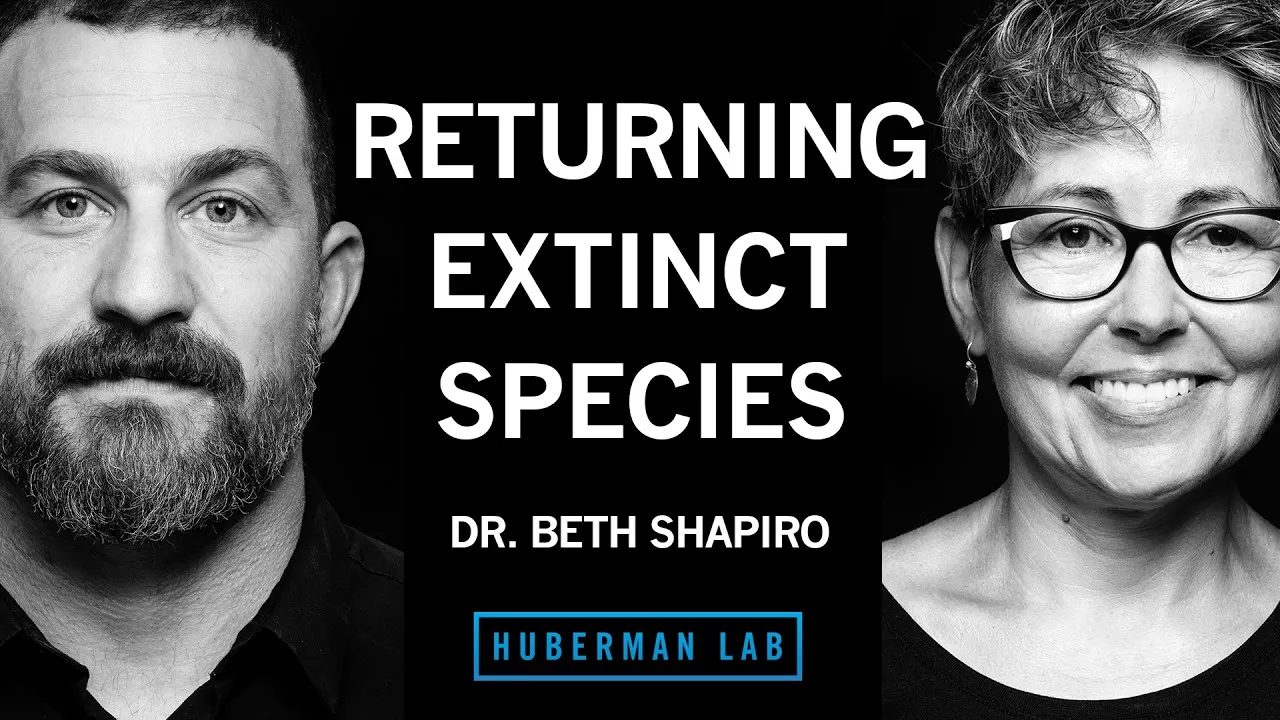
Beth Shapiro says her lab has already engineered and birthed living direwolves
The evolutionary biologist tells Andrew Huberman that de-extinction is no longer a hypothetical future, and her company has three massive engineered wolves to prove it.
Listen on YouTube · Spotify · Apple Podcasts
 WATCH NOW↓
 The direwolves are real, and they are currently about two years old. Dr. Beth Shapiro tells Andrew Huberman on the Huberman Lab that her team at Colossal Biosciences has successfully engineered modern wolves to resurrect the extinct, oversized predator. They did not need a mosquito trapped in amber to pull it off.
The 20-edit resurrection
Shapiro explains that her team mapped the genome from fossilized direwolves to isolate exactly which genetic triggers made the animals larger, more muscular, and lighter in coat color than modern canines. They narrowed the blueprint down to 20 specific edits.
So our direwolves, they have 20 edits that we picked and we sequenced genomes from fossil direwolves. We learned from those genomes what genetic changes made those animals bigger, more robust, light colored in coat and then we engineered those changes into a greywolf genome to recreate the direwolf.
The resulting animals are massive. The two males, Romulus and Remus, weigh north of 120 pounds. They live in a private enclosure, and Shapiro notes they behave entirely like wild animals. But is a grey wolf with 20 tweaked genes actually a direwolf? Huberman presses her on the taxonomic gatekeeping. Evolutionary purists argue that a species is strictly defined by deep, branching genetic history, not an engineered shortcut. Shapiro has zero time for the semantics.
If it looks like a direwolf and it’s able to fill the niche of a direwolf, I’m happy to call it a direwolf.
Not just a vanity project
Building giant wolves with a passing resemblance to pop culture beasts sounds like a billionaire vanity project. Shapiro readily admits they timed their initial DNA sequencing efforts to capitalize on the peak popularity of a certain HBO fantasy show. But the actual science serves a more urgent purpose in conservation.
The tools required to bring back a mammoth, a dodo, or a direwolf are the exact same tools needed to save animals currently teetering on the edge of extinction. Shapiro points to the northern quoll, a tiny Australian marsupial being wiped out by toxic, invasive cane toads. By using synthetic biology to alter a single amino acid in the quoll’s genome, scientists can make the animal immune to the toad’s toxin. The direwolves are essentially a high-profile proof of concept for this kind of genetic rescue.
And when we excite people with the idea of mammoths and dodos and thyloines, we get more engagement and enthusiasm and investment in developing the technology that we can use to stop living species from becoming extinct.
If Shapiro’s vision holds, the era of passive conservation is over. Environmentalists have historically defined success as leaving nature alone. But doing nothing to a destabilized ecosystem is itself a choice, one that currently guarantees less biodiversity tomorrow than we have today. The next generation of conservation will require humans to act as active genetic editors, deciding not just what survives, but what comes back.
- Did scientists bring back the direwolf?
- Yes. Colossal Biosciences used synthetic biology to engineer 20 extinct traits into the genome of a modern grey wolf, resulting in living animals that possess the size, muscle density, and coat color of the extinct direwolf.
- How big are the new direwolves?
- The newly engineered wolves are massive. The two males, Romulus and Remus, weigh more than 120 pounds at under two years old.
- Why is Colossal Biosciences bringing back extinct animals?
- The high-profile efforts to resurrect the direwolf, dodo, and woolly mammoth are essentially proofs of concept. The exact same genetic tools used to recreate extinct traits are actively being deployed to save currently endangered animals from being wiped out by disease and invasive predators.
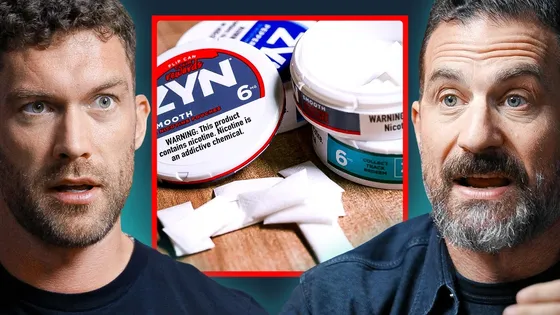
Andrew Huberman says daily nicotine pouches don't boost your brain, they just fix withdrawal
Huberman's rule is brutally unfashionable in the pouch era: if you want nicotine to help performance, don't make it a habit.
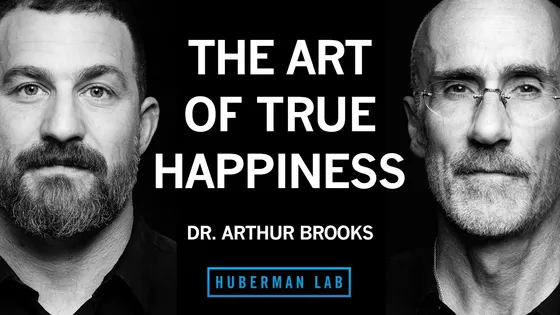
Arthur Brooks says trying to avoid unhappiness makes you miss happiness
On Huberman Lab, Brooks argues that happiness is built from enjoyment, satisfaction, and meaning, and none of the three comes pain-free.
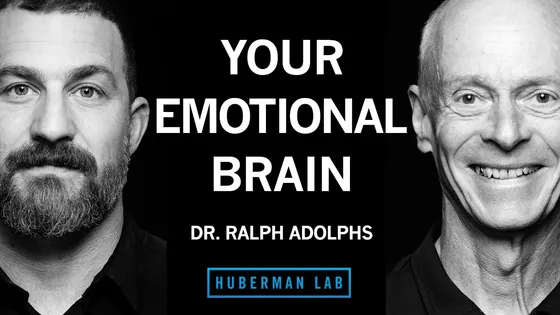
Ralph Adolphs says AI can diagnose your personality from one page of text
The Caltech neuroscientist argues that text may reveal more about your personality than your face does, which is bad news for anyone who thinks their punctuation is innocent.

Dr. Tommy Wood says six months of Norwegian 4x4 intervals protected older adults' hippocampus for five years
The Huberman Lab guest made the anti-cortisol crowd sound like people afraid of rain because floods exist.
The circuit, read weekly. No noise.