Rhonda Patrick says 10,000 steps should be replaced by 10 minutes of hard exercise
On The Diary of a CEO, Patrick makes the case that a short, nasty interval session can do things a polite walk never will.
Listen on YouTube · Spotify · Apple Podcasts
 WATCH NOW↓
Dr. Rhonda Patrick said on The Diary of a CEO that people should replace the 10,000 steps obsession with at least 10 minutes of vigorous-intensity exercise. The walk-your-way-to-wellness era just got shoved into a locker by a woman who really, really wants you to meet lactate.
Patrick, the biomedical scientist behind FoundMyFitness, is not saying walking is useless. Walking is great. Walking is democracy for knees. But her point is that the wearable-fitness brain has confused a neat number with a complete prescription. Ten thousand steps can be soothing, social, and metabolically helpful. It usually does not make you feel like your lungs are filing a complaint with HR. That, for Patrick, is the missing signal.
But I think we need to change the 10,000 steps to at least 10 minutes of vigorous intensity exercise.
This is a good podcast claim because it is simple enough to be dangerous. Ten minutes sounds tiny. Vigorous is where the bill arrives. Patrick is talking about work hard enough that you’re not chatting through it, the kind of effort that pushes your body into making lactate, which she frames not as the old gym-class villain but as a messenger molecule with a résumé.
The 10 minutes are not magic. The intensity is.
The specific workout Patrick keeps returning to is the Norwegian 4 by 4, a protocol beloved by exercise researchers and feared by anyone who has tried to look casual on an assault bike. You warm up, go hard for four minutes, recover for four minutes, then repeat that four times. She says a bike, rower, stationary bike, or assault bike is ideal, though running can work if that’s your thing and your joints have not hired legal counsel.
Her minimum effective dose answer is surprisingly modest: once a week, possibly using a one-minute-on, one-minute-off interval workout. For stronger cardiorespiratory effects, she mentions Tabata work, 20 seconds on, 10 seconds off, repeated eight times and potentially done twice. But the gold-standard halo goes to the Norwegian intervals, partly because of the heart-aging data she cites.
being part of an exercise protocol was shown to reverse the structural changes that occur with age in the heart by 20 years.
That line is the shiny object, and it needs a little adult supervision. Patrick is referring to work by Ben Levine at UT Southwestern involving sedentary middle-aged adults put through a progressive training program over two years. The sexy version is: 50-year-old hearts looked 30 again. The less viral version is: participants built up over months to a serious weekly routine, about five to six hours of exercise, including one or two Norwegian 4 by 4 sessions, plus other moderate-to-vigorous training and strength work.
So no, a single weekly sufferfest is not the same as a two-year supervised protocol. Patrick knows that, and she says people should work their way up. Still, the broader point holds: exercise that challenges the heart is not merely calorie theater. It changes capacity. It asks the cardiovascular system to adapt, and the system, annoyingly, would like you to earn it.
Lactate gets a rebrand
The funniest energy in the episode comes from Patrick’s enthusiasm for lactate, the molecule many people still vaguely associate with burning muscles and shame. She credits George Brooks’s work at UC Berkeley for helping overturn that old story. Lactate, in her telling, is fuel, signal, and courier. The heart uses it. The brain uses it. The body listens when muscles start yelling chemically.
it’s like your muscles are these little chemical pharmaceutical factories.
That is a very Rhonda Patrick sentence, equal parts lab meeting and Marvel origin story. But it is also the best explanation for why she thinks a step count is an incomplete idol. Vigorous intervals produce lactate, and Patrick connects that lactate to brain-derived neurotrophic factor, or BDNF, which she calls a kind of “miracle grow” for the brain. She also links hard exercise to norepinephrine, serotonin, focus, mood, impulse control, and neuroplasticity.
This is where the pitch gets big. Maybe too big for 17 minutes of transcript. The mechanisms are real enough, but the listener should not walk away thinking a few grim minutes on a rower are a guaranteed cognitive renovation. The stronger claim is narrower and better: vigorous exercise creates physiological signals that easy movement often does not, and those signals are part of why cardiovascular health, brain health, and longevity people keep circling back to intensity.
The shortcut question gets swatted down
Steven Bartlett asks the obvious Silicon Valley goblin question: if lactate is so great, why not just drink it or inject it and skip the misery? Patrick says sodium lactate has been studied in traumatic brain injury patients and can be consumed by the brain, but oral lactate gets complicated because the gut uses a lot of it first. Also, exercise is not one molecule. It is a whole biochemical riot.
if you could pill up what exercise does, it I mean, it’s so many things, right?
That is the cleanest version of Patrick’s argument. The 10,000-step target is tidy, trackable, and marketable. The 10-minute hard-exercise target is messier because it demands honesty. Were you actually pushing, or were you performing wellness next to a machine?
If Patrick is right, the useful question is not whether you hit a round number by bedtime. It is whether, at some point this week, you made your muscles send the message.
- What did Rhonda Patrick say about 10,000 steps?
- Rhonda Patrick said people should stop treating 10,000 steps as the gold standard and instead aim for at least 10 minutes of vigorous-intensity exercise. Her argument is that hard intervals trigger lactate production, cardiorespiratory adaptation, and brain-related benefits that low-intensity walking does not produce at the same level.
- What workout did Rhonda Patrick recommend on The Diary of a CEO?
- Patrick described several options, from a minimum once-a-week interval session to Tabata-style work. Her favorite serious protocol was the Norwegian 4 by 4, which means four minutes hard, four minutes easy, repeated four times, ideally on a bike, rower, or similar cardio machine.
- Did Rhonda Patrick say exercise can reverse heart aging?
- Yes. Patrick cited research from Ben Levine at UT Southwestern in which sedentary 50-year-olds followed a progressive two-year exercise program and showed heart changes she described as making their hearts look more like those of 30-year-olds. The catch is important: that study was not a casual 10-minute habit, but a long, structured program that built up to several hours of weekly training.
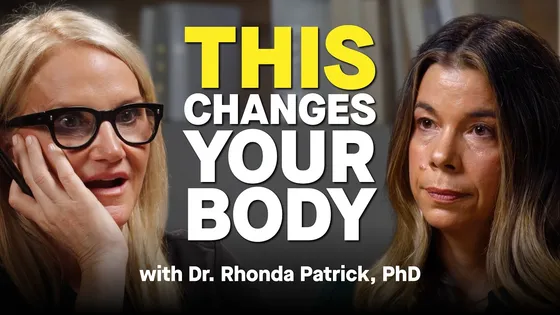
Rhonda Patrick says 1 minute of breathless exercise beats 53 minutes of walking around your house
The researcher behind the FoundMyFitness newsletter just made your gym membership guilt optional and your stair climb mandatory.
Darren Candow says UFC fighters should look at creatine before getting hit because rodent studies show faster concussion recovery
The creatine researcher’s boldest claim was not about bigger lifts, it was about whether the gym’s most boring powder might belong in the fight camp brain-protection kit.
Brian Greene says by the time we see an AI intelligence explosion, it may be too late to stop it
The physicist is not buying every 2029 superintelligence prophecy, but he thinks the math of exponential growth is exactly what makes AI risk so nasty.

Rena Malik says people who have sex once a week live 49 percent longer than people who have sex once a year
The urologist brings a big longevity stat to The Diary of a CEO, then quietly admits the boring but crucial part, sex is probably a marker of health as much as a cause of it.
The circuit, read weekly. No noise.