Dr. Alan Castel says feeling younger than your age predicts how long you'll live better than your actual age
The UCLA memory researcher gives the Huberman crowd a squishy variable with surprisingly hard stakes.
Listen on YouTube · Spotify · Apple Podcasts
 WATCH NOW↓
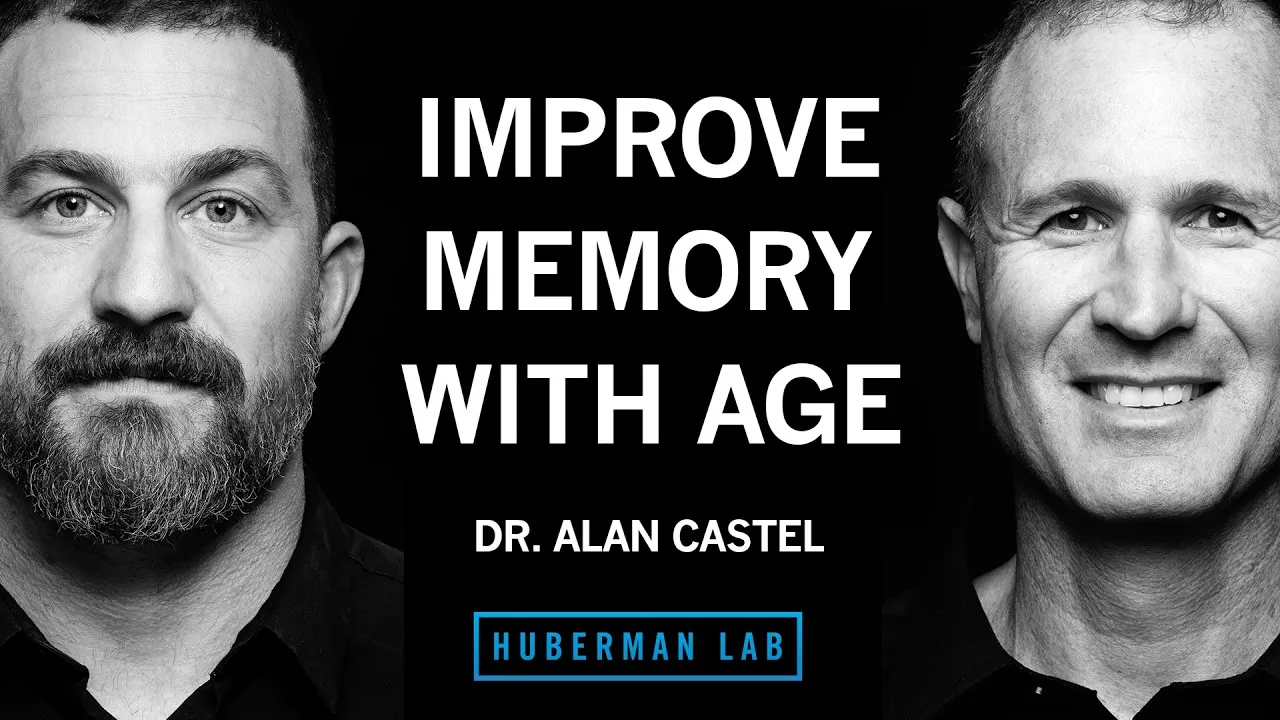
 Alan Castel came to Huberman Lab with a claim that sounds like it escaped from a wellness mug but is actually a research finding: how old you feel may predict how long you live better than how old you are. Not your birth certificate. Your felt age. The DMV is shaking.
Castel, a UCLA psychologist and memory researcher, is not selling fairy dust. That is what makes the claim more interesting. He is the kind of scientist who can talk about the Apple logo, eyewitness contamination, hotel fire exits, John Wooden, and older adults forgetting the right things, then sneak in a line that should make every anti-aging spreadsheet person look up from their glucose monitor.
after the age of 40, most people feel about 20% younger than their actual age.
That little psychological tax break, 50 feeling like 40, 70 feeling like 56, could be self-flattery. It could also be a crude but useful scan of the whole organism. If you feel younger, maybe you move more. Maybe you hurt less. Maybe you still make plans, still have people, still believe your knees are annoying rather than prophetic. Castel’s point is not that attitude beats biology. It is that attitude keeps showing up inside biology wearing a fake mustache.
The soft metric with hard consequences
that subjective age is a better predictor of how long you’ll live than your biological age.
For a show that often speaks fluent biomarker, VO2 max, sleep architecture, blood lipids, hippocampal volume, Castel’s subjective age riff is almost rude. It barges into the lab coat party in comfortable shoes. But it fits his larger argument about cognitive aging: aging is real, decline is real, and the story is still not a straight downhill line with a tasteful banister.
He points to the weird diversity of aging, the 100-year-old doing beautifully, the 60-year-old not so much. He talks about nuns whose brains showed plaques and tangles but whose behavior stayed high functioning. He talks about walking three or four times a week improving memory related brain function. He talks about balance training because a fall can yank a person out of motion, and motion is part of the whole cognitive bargain.
The verdict, without putting it in a lab centrifuge: Castel’s claim is believable as a predictor and dangerous as a slogan. Feeling younger is probably not a magic cause. It is more likely a dashboard light, one that glows when the engine underneath still has decent fuel, decent suspension, and a driver who has not decided the trip is basically over.
those who have a positive attitude live longer, they’re less likely to develop dementia.
There is the Huberman-friendly part. Beliefs are not just vibes in a cardigan. Castel ties positive aging attitudes to longevity and dementia risk, then immediately adds the sane caveat: maybe the pathway is lower stress, better behavior, more agency. Good. Keep the incense away from the fMRI machine.
Memory gets pickier, which may be the point
Castel’s most generous idea about memory is that getting older is not simply losing files. Sometimes it is learning which files never deserved a folder. Older adults, he says, can become better at remembering what they care about and better at forgetting what doesn’t fit or doesn’t matter. If your phone has ever eaten 18 minutes of your life with a story you did not need, this sounds less like decline than mercy.
That selectivity also explains why the conversation keeps returning to curiosity. Castel separates trait curiosity, the general personality setting, from state curiosity, the spark that happens when a fact hooks you right now. His research suggests older adults may get especially good at following the sparks that matter to them. This is not the same as being open to everything. It is being open on purpose.
This is where Castel gets sneakily anti-biohack, or at least anti-one-true-hack. The superagers he describes are not all marathoners living on blueberries and contempt. They are often people with routines that smuggle in exercise, connection, purpose, and challenge. They walk because life asks them to walk. They mentor because someone is there to be mentored. They adapt because aging keeps changing the terms.
That is less glamorous than a supplement stack. It is also harder to fake.
The protocol crowd has a problem
The problem is that subjective age cannot be bought in a bottle or scheduled for 6:10 a.m. between sunlight and electrolytes. You can influence it, probably, by doing the unsexy things Castel keeps naming: move, sleep, challenge yourself, keep people close, don’t let a sore knee become a philosophy, and resist the cultural script that says older means smaller in every direction.
Andrew Huberman is most animated when Castel’s ideas touch friction, the gap between where you are and where you want to be. That gap shows up in learning, in balance, in walking uphill, in trying something new at the restaurant instead of ordering the same safe thing forever. Castel’s message is not that comfort kills you. It is that comfort, unchallenged, starts redecorating your life as a waiting room.
If Castel is right, the useful question is not, how old am I? It is, what age am I practicing being today?
- Does feeling younger actually predict living longer?
- Castel says subjective age, meaning how old you feel, predicts lifespan better than chronological age. That doesn't mean pretending you're 32 will trick your mitochondria. It likely captures a bundle of real signals, movement, pain, mood, social connection, and whether you've accepted decline as destiny.
- What does Alan Castel say happens to subjective age after 40?
- He says that after 40, most people report feeling about 20 percent younger than they actually are. Castel treats that gap less as vanity and more as useful psychological data, a clue to how people see their own aging and what they still believe they can do.
- What is Castel's practical advice for aging well?
- His advice is not one weird pill, one perfect supplement, or one heroic gym routine. He keeps circling back to attitude, adaptation, balance, social connection, curiosity, walking, and doing enough difficult things to keep the brain from going into retirement before the body does.
Jeff Cavaliere Says Your Back Pain Is a Glute Problem
The Athlean-X founder makes the case that the small muscles everyone ignores are the only reason the big lifts keep working.
Dr. Abud Bakri Knows Where the Peptides Come From, and It's All China
A 33-year-old internal medicine physician walks into the Huberman Lab and proceeds to explain why millions of people are injecting compounds sourced from one Croatian research group and one country.
Cesar Millan says learning how to walk your dog eliminates 90 percent of behavior problems
On Huberman Lab, the Dog Whisperer reduced most canine chaos to one blunt prescription, walk the dog before you try to love the dog into sanity.
Beth Shapiro says her lab has already engineered and birthed living direwolves
The evolutionary biologist tells Andrew Huberman that de-extinction is no longer a hypothetical future, and her company has three massive engineered wolves to prove it.
The circuit, read weekly. No noise.