Jay Anderson says Egypt’s Menkaure Pyramid has the same unexplained stone nubs as Peru’s megalithic walls
The ancient-architecture researcher argues that matching protrusions on stones in Egypt and Peru make the standard timeline look stranger than advertised.
Listen on YouTube
 WATCH NOW↓
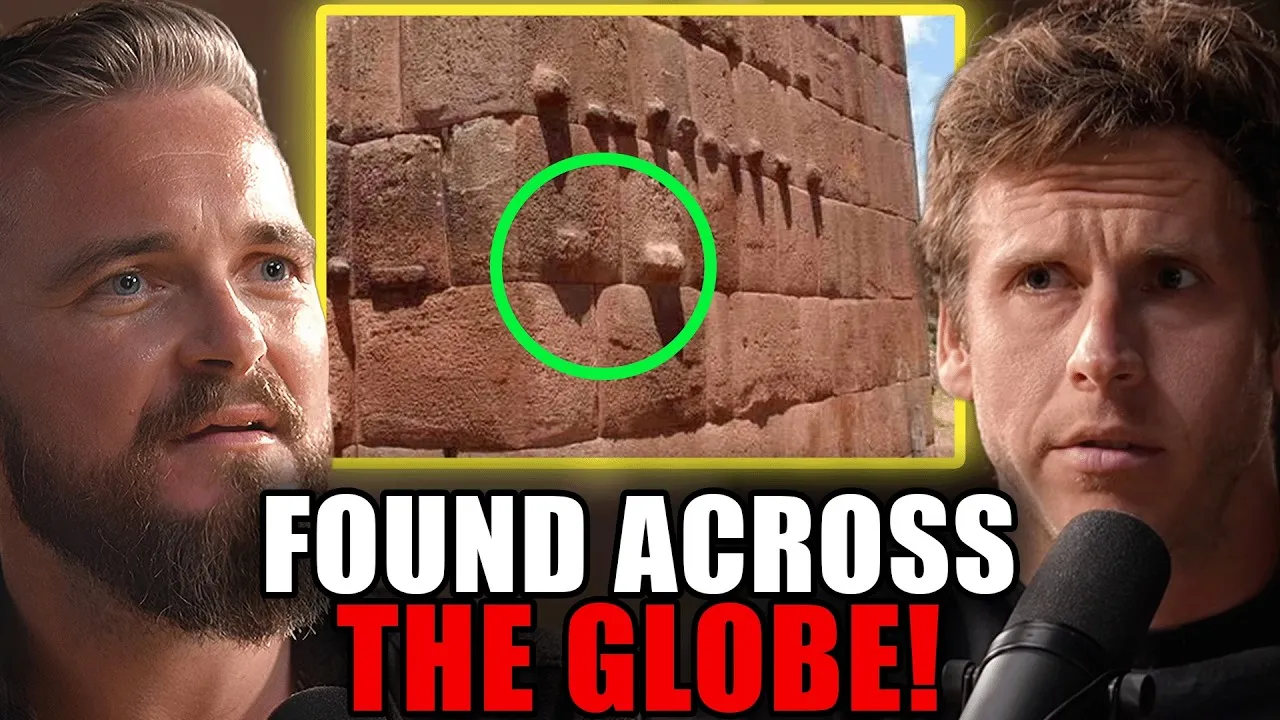
Jay Anderson told the Danny Jones Podcast that the outer casing stones of Egypt’s Menkaure Pyramid have the same unexplained stone-nub pattern he sees on megalithic blocks in Cusco, Peru. Anderson argues the match is strange because the accepted timelines put the Inca works around 450 to 500 years old, while Menkaure is more than 4,000 years old by mainstream estimates.
This is exactly the kind of claim that makes ancient-megalith internet light up like a cursed pinball machine. Not aliens, mercifully. Not yet. Just two little protruding stone knobs, sitting there like architectural acne, refusing to fit politely into the brochure version of archaeology.
Jay Anderson points to the surviving granite casing stones at Menkaure, the smallest of the three major pyramids at Giza, and compares them to the famously tight, pillowy masonry in Cusco, including temple walls associated with the Inca world. His claim isn’t merely that old buildings sometimes have bumps. It’s that the same specific weirdness, pairs of nubs protruding from the bottoms of blocks, appears in places that should not be sharing construction quirks if the standard story is complete.
you’ve got this pattern of two nubs on the bottom coming out of these megalithic blocks.
The nub theory is better as a problem than as an answer
Anderson’s strongest move is not pretending the nubs solve everything. His best point is narrower and better: the usual explanation sounds thin. Archaeologists often describe these protrusions as bosses or lifting points, which is plausible in plenty of cases. Ancient builders needed to move, dress, position, and finish stones. Leaving little handles or unfinished patches is not bizarre on its face.
But Anderson argues the details don’t behave. If the nubs were simply for lifting, he asks, why are they often irregular? Why are some too small? Why are they not placed with the clean symmetry you would expect from a practical rigging system? That does not prove a lost global builder culture. It does mean the phrase “lifting point” can become a broom, sweeping every inconvenient bump into the same dustpan.
The nubs haven’t been properly explained. The mainstream says they’re lifting points, but you find them in very strange like, you know, non-symmetrical points of the stone. Too small to be a lifting point in many cases.
This is where the episode gets usefully uncomfortable. Anderson frames the gap between ancient Egypt and Peru as both geographic and chronological. The Inca empire’s imperial height was short, roughly a century before the Spanish conquest. Menkaure belongs to the Old Kingdom, deep in the third millennium BCE. If both sites really share a distinctive masonry habit, the listener has three options: coincidence, a practical technique that pops up independently, or something much stranger.
the same architectural anomaly and it’s an architectural anomaly because we haven’t got a good explanation for the nubs yet.
Then comes the liquid-stone rabbit hole
Anderson also brings up an even wilder idea: that some ancient stonework may have involved breaking down stone and re-forming it, not merely cutting and stacking it. He cites a Budapest-based experimenter named Marcel Foti, who he says has been trying to recreate a kind of reconstituted stone process using archaic materials. This is the part of the episode where the reasonable listener should keep one hand on the skepticism rail.
He’s actually trying to prove that they were making liquid stone and then setting it back into real stone again.
To be blunt, “liquid stone” is a much bigger leap than “the nubs are underexplained.” The first asks for a radical construction technology. The second asks for humility about a physical feature that may have been over-filed under “lifting.” The episode is better when it stays with the nubs, because the nubs are visible, specific, and annoyingly persistent. You can argue with them. You can Google them. You can stare at them until your lunch break becomes a theory board.
Danny Jones nudges the conversation toward other ancient mysteries too, including Easter Island’s moai and transport theories, but the Menkaure-to-Cusco comparison is the thing with teeth. It gives the alt-archaeology crowd something concrete instead of the usual fog machine. Anderson is not owed his grander implications, but he has put his finger on a real genre of archaeological irritation: small physical details that survive long after tidy explanations have stopped sounding tidy.
If the nubs are just unfinished lifting bosses, fine. Show the pattern, show the tooling, show why the irregular examples still fit. If they aren’t, the next question is not “who built everything?” It is smaller and more dangerous: how many ancient construction habits have we mistaken for decorative noise?
- What did Jay Anderson say about Egypt and Peru stone nubs?
- Jay Anderson said the casing stones on Egypt’s Menkaure Pyramid show protruding stone nubs similar to those found on megalithic blocks in Cusco, Peru. His point is that the feature is hard to explain as ordinary lifting hardware because the nubs can be irregular, small, and oddly placed. He argues the match is especially strange because the sites are separated by geography and by thousands of years in the standard chronology.
- Does Jay Anderson think the stone nubs prove Egypt and Peru were connected?
- He stops short of presenting proof of direct contact, but he clearly treats the repeated nub pattern as a clue that mainstream explanations are incomplete. The stronger claim is architectural, not historical: the same odd construction signature appears in places that conventional timelines do not easily connect.
- What is the mainstream explanation for the nubs?
- Anderson says the standard answer is that they were lifting points, sometimes called bosses. He rejects that as too neat, arguing that their size, placement, and lack of symmetry make them a poor fit for a simple lifting explanation.
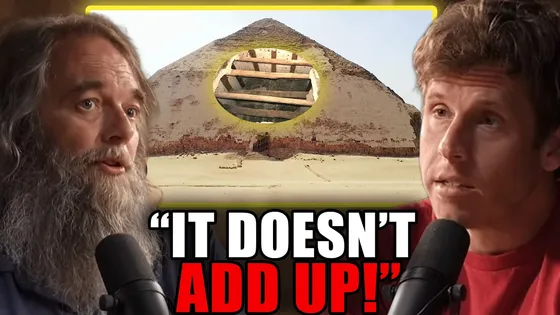
Dan Richards says Egyptologists used Bayesian modeling to delete carbon dates that contradicted the pyramids timeline
A self-described electrician-turned-researcher makes a specific, technical accusation against mainstream Egyptology, and the accusation is harder to dismiss than it sounds.

Luke Reagan says he found ancestral Pueblo pit houses on Epstein's New Mexico ranch
The weird part is not that the Epstein ranch inspired conspiracy hunting, it is that the thing Reagan says he found is probably much older and less lurid than the internet wanted.
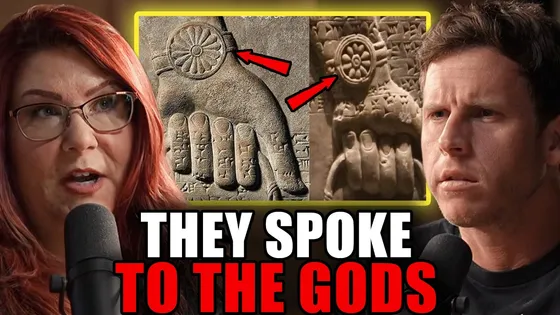
Heather Lynn says the Anunnaki wristwatches were poppy cuffs from Nimrud, not alien watches
On Danny Jones, Lynn gives the ancient aliens internet a delightfully terrestrial answer, then pushes it into a bigger claim about opium, mushrooms and Mesopotamian altered states.
Heather Lynn says archaeology was primarily used as a cover for spying operations
On Danny Jones Podcast, Lynn ties cabinets of curiosities, King Tut money, and Middle East mapmaking to archaeology's oldest dirty secret.
The circuit, read weekly. No noise.