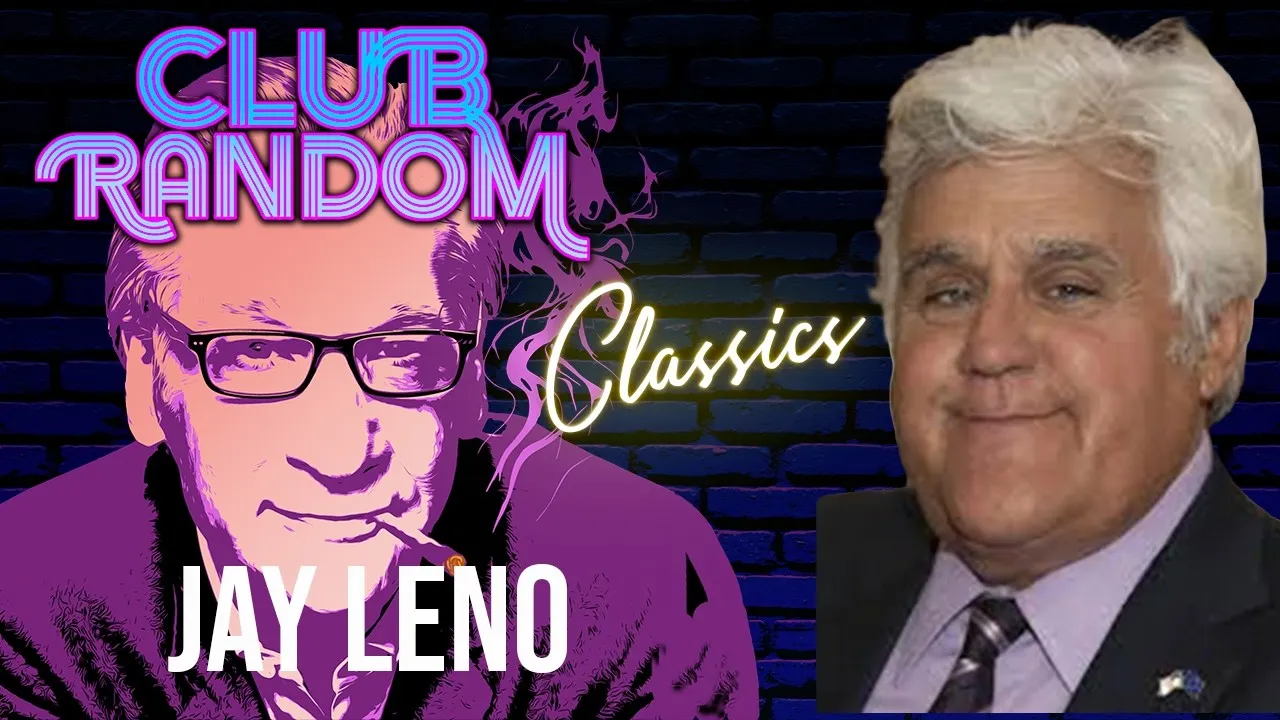
Jay Leno says he hid in an NBC closet twice to hear executives decide The Tonight Show
The old late-night villain story gets funnier when Leno describes himself less as a backstabber than as a network sitcom burglar with incredible timing.
Listen on YouTube
 WATCH NOW↓
 Jay Leno’s nicest-guy-in-show-business image has always had one hilarious flaw: apparently the man was willing to go full Watergate in a network closet. On Club Random, Jay Leno tells Bill Maher that he hid in an NBC closet twice to listen to executives discuss the future of The Tonight Show, including the meeting where he says Jack Welch backed him.
This is the useful thing about Leno as a late-night character. He does not sell himself as wounded, or brilliant, or misunderstood. He sells himself as the guy who showed up early, took scale, called affiliates, did AM Buffalo, and, when necessary, became a piece of office furniture with ears.
I had a hunch that that um that Jack Welch was on my side. And when I when when they were having that meeting and I was listening in, I heard him say, “Why don’t we go with Leno? He seems funny. He seems to work good. Seems to be a hard worker. I like him.”
The closet story is not just a goofy anecdote. It is Leno’s whole defense brief in miniature. The public caricature of Leno in the late-night wars is the bland company man who somehow kept ending up with the chair. Leno’s version is stranger and more persuasive: he was a company man, yes, but one who understood the company better than the company understood itself.
I did it twice. And the second time I heard Warren Littlefield say, you know, somehow I think Leno knows what goes on in this room.
The nice guy was also doing counterintelligence
Maher keeps trying to turn Leno into a victim of network stupidity, and to be fair, he has material. Maher says Leno got fired twice for the crime of being number one. Leno does not quite take the bait, because taking the bait would require sounding bitter, and bitterness is apparently the one collectible he never kept in the garage.
I said, “I’m number one.” You know what they said, Jay? We want what’s above number one.
That quote is so pure it should be bronzed and placed outside every network executive bathroom. It also gets at why Leno’s account is both credible and self-serving. Credible, because television executives absolutely do talk like people trying to invent a number bigger than first place. Self-serving, because Leno’s story always returns to the same moral: if he survived, it was because he was cheaper, tougher, less vain, and more willing to grind than everybody else.
He says he had no agent or manager, which Maher finds almost insane given that Ari Emanuel was, in Maher’s telling, in NBC’s ear on the other side. Leno counters with the most Leno possible answer: he preferred to rise and fall by his own hand. Then he tells a story about guest-hosting for $512 a night, scale, while other comics were asking for $25,000. The punchline is not a joke. NBC could save money and keep the ratings. Guess who became permanent guest host?
Leno’s Letterman argument is brutally practical
The most Reddit-ready part, after the closet, is Leno’s claim about David Letterman. In Leno’s telling, the great succession drama was less Shakespeare and more spreadsheet. Johnny Carson was a hit at 11:30, Letterman was a hit at 12:30, and NBC did not want to turn one sure thing into one gamble and one hole.
Dave never had the Tonight Show.
That’s a sharp line, and Leno backs it with the network logic. If NBC moved Letterman to 11:30, Leno says he would have gone to CBS or somewhere else, leaving NBC exposed at 12:30. He even says he asked whether Letterman had the job and was told no, Letterman was a hit where he was. This is not the romantic version. It is the parking-lot version. Two hits are better than one legacy coronation.
The Conan O’Brien chapter gets the same treatment. Leno says NBC demanded that he announce he would leave in five years, then came back later with the 10 p.m. talk-show plan after Craig Ferguson started beating Conan. He says Jeff Zucker promised to pay his entire staff for two years no matter what happened, which is the kind of detail that makes the story feel less like a conspiracy and more like a terrible corporate compromise with fluorescent lighting.
Does this absolve Leno in the court of late-night history? Not fully. Jimmy Kimmel’s resentment, which Leno acknowledges, did not come from nowhere. Conan fans did not hallucinate the mess. But Leno’s closet story punctures the clean villain narrative. The guy wasn’t just handed the keys by faceless suits. He was listening through the drywall while the suits tried to figure out what they already had.
The late-night wars were about taste, ratings, Johnny Carson’s shadow, Letterman’s cool, Conan’s promise, and network panic. Also, apparently, closet acoustics.
- What did Jay Leno say he heard while hiding in the NBC closet?
- Leno says he heard Jack Welch argue that NBC should go with him for The Tonight Show because he was funny, worked well, and seemed like a hard worker. The story is classic Leno self-mythology: humble workhorse on the outside, sitcom spycraft on the inside.
- Did Jay Leno say David Letterman was promised The Tonight Show?
- No. Leno says Letterman was a giant success at 12:30, but NBC wanted to keep both hits where they were. His version is that NBC never intended to move Letterman down to 11:30 because doing so would have risked losing Leno to another network.
- What was Leno's explanation for the Conan O'Brien mess?
- Leno says NBC told him to announce he would leave in five years, then later offered him a 10 p.m. show and guaranteed his staff would be paid for two years. He denies deliberately sabotaging Conan's Tonight Show, framing the whole thing as a bad network fix that collapsed on contact with reality.
Byron Allen says Johnny Carson let him strike The Tonight Show set for his own show
Allen’s best story on Club Random isn’t about becoming a billionaire, it’s about getting the king of late night to say yes to an absurdly intimate favor.
Jack Whitehall says Channel 4 pulled his show at 11 p.m. because Michael Jackson died after it had a pedophile sketch about him
On Club Random, Whitehall described the sort of pre-smartphone comedy near-disaster that now sounds less like showbiz lore than a deleted scene from Broadcast Standards Hell.
Lisa Kudrow says Sam Kinison was shooting heroin on set while they filmed a sitcom together
The Friends icon drops a genuinely startling piece of TV history buried inside a very pleasant chat about mushrooms and Spartacus.
David Foster says Whitney Houston’s “I Will Always Love You” was a 10-minute rough mix he made to trick Clive Davis
The producer says one of the cleanest, biggest pop records ever came from a DAT tape he never meant to survive the summer.
The circuit, read weekly. No noise.