Parmy Olson says Demis Hassabis saw AI as a quest to get closer to God
The author argues that AGI talk keeps sounding religious because the technology is too huge and weird for ordinary tech language to handle.
Listen on YouTube
 WATCH NOW↓
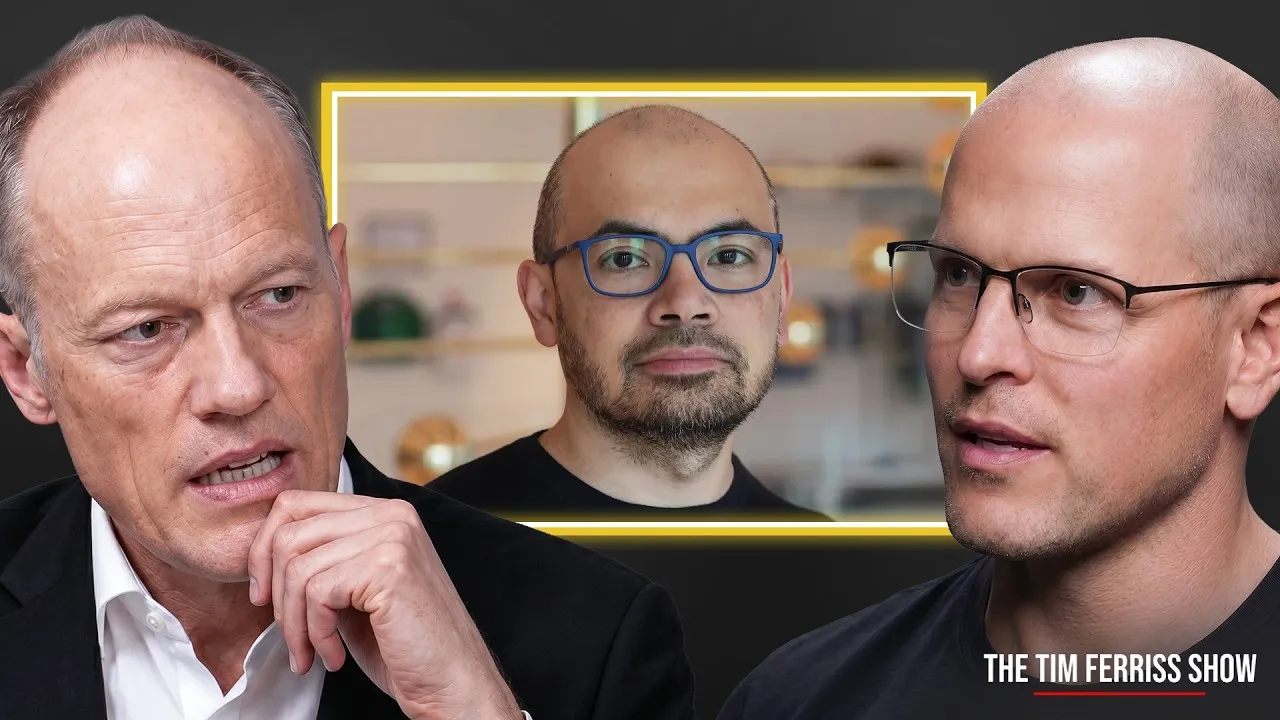
Parmy Olson told The Tim Ferriss Show that Demis Hassabis described DeepMind’s artificial-intelligence work as a quest that could bring him closer to what he would call God. Olson’s larger claim is that AGI researchers keep reaching for religious language because superintelligence is too powerful, strange, and scary for ordinary tech talk. Silicon Valley has always loved a founder myth, but this is not a hoodie-and-whiteboard origin story. This is incense with a GPU cluster.
The useful distinction is this: Olson is not saying Hassabis walked into a North London park and announced that DeepMind was printing a deity. She is saying the people closest to Artificial Intelligence keep using the same words humans use when they hit the edge of explanation. God. Rapture. Witch-burning. Annihilation. The pitch deck has become a prayer book.
DeepMind, but make it scripture
Olson’s most startling detail is Hassabis describing his nights after the kids went to sleep, reading scientific papers until 4 a.m. That is already a very specific kind of founder monasticism. The robe is a fleece. The candle is a laptop screen.
Reality is staring at me, screaming at me, calling at me to understand it. And I have to understand it and if I can understand it, it’s like understanding nature better and therefore understanding the intelligence that might have created nature and I would be closer to what I would call God.
That quote is not a confession of cult leadership. It is more interesting than that. It is the language of a secular scientist whose ambition has gotten so large that normal verbs start to fail. Build, optimize, scale, train. Fine. But if the goal is to understand intelligence itself, and maybe create a machine that rivals or exceeds human cognition, the vocabulary drifts upward. Soon you are not just doing research. You are trying to read the source code of creation.
Olson’s verdict is persuasive as anthropology and a little slippery as theology. The religious language does not prove that AI founders are believers. It proves that the mythic register is very convenient when your product roadmap includes something that might change civilization, or wreck it.
The fire pit was not subtle
The episode’s funniest and most alarming image belongs to Ilya Sutskever, the former OpenAI chief scientist. Olson describes a retreat scene where Sutskever tried to dramatize AI safety with the sort of prop comedy that would get a medieval village very excited.
And he produced an effigy, which was supposed to represent a malign AI. And he put it into the fire pit, and he burnt it like a medieval cleric putting a witch to death.
That is the whole AGI psyche in one tiny bonfire. These are people talking about alignment, compute, model capability, and data, then suddenly someone is feeding a symbolic demon to the flames. You can laugh at it, and you should, because it is ridiculous. You should also notice that ritual tends to appear when people feel both powerful and helpless.
Olson also points to Shane Legg, Hassabis’s DeepMind co-founder, predicting in 2009 that superintelligence would arrive in 2030. She calls the prediction “unbelievably spot-on,” which is a little eager in 2026. The calendar has not cashed that check yet. But the emotional beat she describes is the telling part: Legg talking about a threatening intelligence with an excited smile, as if doom had wandered into the room wearing party shoes.
And you realize that for humans to contemplate annihilation is absurd. And the absurd is a close cousin of humor.
That is the best defense of all the weirdness here. The God talk is not just self-importance, though there is plenty of that in the water supply. It is also a coping mechanism. When engineers stare at a possible intelligence explosion, they reach for the oldest human file folder marked “things bigger than us.”
all through this topic, there is this religious expression because religion is the lexicon for dealing with something that we find too mysterious to really understand.
- What did Parmy Olson say about Demis Hassabis and God?
- Olson said Hassabis described his late-night study of scientific papers as part of a drive to understand reality, nature, and the intelligence that might have created nature. In her telling, Hassabis saw that pursuit as bringing him closer to what he would call God.
- Did Olson say AI founders literally think they are building God?
- Not literally. Her argument is sharper than that. She says AGI researchers reach for religious language because superintelligence feels too powerful, mysterious, and potentially dangerous for normal startup vocabulary.
- What was the Ilya Sutskever fire-pit story?
- Olson said Ilya Sutskever once used an effigy to represent a dangerous, misaligned AI at a retreat, then burned it in a fire pit. She treats the scene as an example of how safety talk around AI can slide into ritual.
Sebastian Mallaby says AI still really sucks at writing anything longer than about 800 words
The author’s AI rule is simple: let the machine brief you, but don’t let it become the part of your brain that writes.
Tim Ferriss says interview-format podcasts are largely dead and AI will consume them
The king of optimized longform interviews just called the format a sinking island, which is inconvenient for the island.

Tim Ferriss says AI could drive his nonfiction book sales down 67 percent in 2026
Ferriss's most useful AI warning isn't about robots writing books, it's about robots making certain books feel unnecessary.
Sebastian Mallaby says the Trump administration took control of who gets Anthropic's cyberattack model
The Infinity Machine author argues that AI regulation has already moved from abstract safety talk to Washington deciding who can touch the dangerous stuff.
The circuit, read weekly. No noise.