Sebastian Mallaby says the U.S. should loosen China chip controls if they block an AI safety deal
The Council on Foreign Relations writer argues that China is more reachable on AI safety than U.S. officials think, and that export controls have failed to buy America the lead he expected.
Listen on YouTube
 WATCH NOW↓
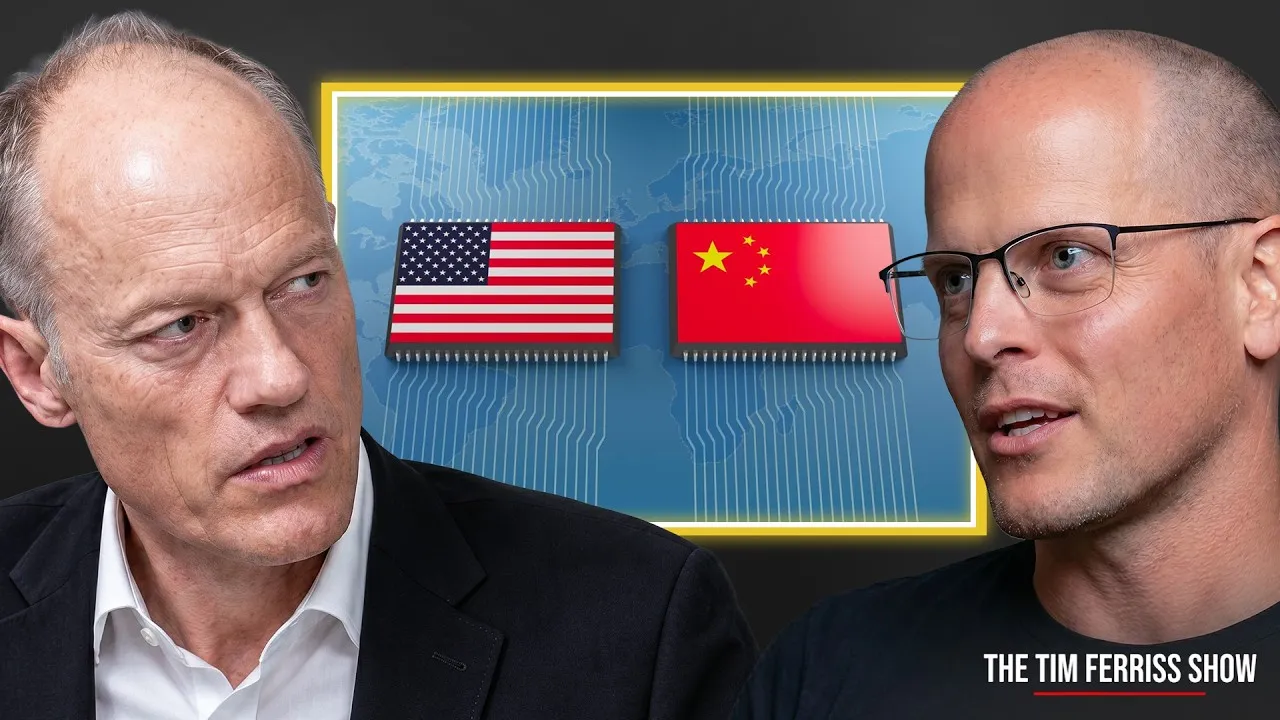
On The Tim Ferriss Show, Sebastian Mallaby said the U.S. should prioritize AI safety talks with China, even if that means loosening chip export controls. Mallaby said Chinese AI leaders raised safety unprompted on his China trip, and he argued Washington is wrong to assume Beijing will not negotiate.
This is the kind of foreign policy sentence that makes half of Washington reach for a lanyard and the other half reach for blood pressure medication. Mallaby is not pitching himself as a Davos vibes ambassador. He says he backed the October 2022 chip controls loudly, wrote in favor of them, and remains perfectly happy with American power. Which is what makes the reversal worth hearing.
the extent to which people brought up the issue of AI safety.
A hawk discovers a door
Mallaby says Biden administration policy veterans had prepared him to expect a wall in China. The theory was simple enough: Western governments have the atom bomb, the Cuban missile crisis, and a long tradition of being haunted by their own inventions. China, in this telling, sees technology as the engine of its rise and catastrophe as political collapse, not machine risk. Then Mallaby visited AI leaders at places including Huawei, Hikvision, and Ant Group, and found a different opening.
the door is actually open to a dialogue with China about preventing bad guys doing bad stuff with AI.
The key word is not trust. It is interest. Mallaby’s argument is that Beijing does not need to share Silicon Valley’s dinner party anxieties about superintelligence to care about cyber attacks, bioweapons, chemical weapons, and powerful open weight models floating around the internet like cursed PDFs. China, as he puts it, loves regulating the internet. That is not a moral compliment. It is a bargaining premise.
His analogy is the nuclear non-proliferation system: the U.S. and the Soviet Union still hated each other, but they could cooperate to keep nuclear tools out of more hands. Mallaby thinks AI safety needs a similar channel with China. He even reaches for Nikita Khrushchev, the shoe-banging Soviet leader, to swat away the claim that China is too difficult to talk to. If America could negotiate with that guy, Mallaby’s point goes, it can pick up the phone now.
The reversal is the story
The stronger part of Mallaby’s case is that he admits what changed. He supported chip export controls because, in theory, starving China of frontier chips would starve China of frontier models. Three and a half years later, he says, that is not what happened. His estimate, based on the best studies he cites, is that U.S. frontier models are roughly eight months ahead, and that the practical application gap may be smaller or even gone.
the chip export controls have not delivered what I hoped would be the big advantage.
That is a real concession, not a think tank pirouette. It also deserves pressure. Export controls can fail to deliver a knockout blow and still slow a rival down. A safety agreement can sound elegant and still collapse the second enforcement gets ugly. AI is not uranium. Model weights copy beautifully, inspections are murky, and the bad version of this deal is a photo op with a commemorative pen and a thousand loopholes wearing fake mustaches.
Still, Mallaby’s useful heresy is treating controls as an instrument, not a sacrament. If they buy time, fine. If they block a pact on open weight models and catastrophic misuse, not fine. That is a sharper position than the usual China panic loop, where every tool becomes proof of seriousness and nobody asks whether the tool worked.
I would prioritize collaboration with China, and if that meant, you know, loosening up a little bit on the export controls, I would be okay with that.
- What did Sebastian Mallaby say about China chip controls?
- Sebastian Mallaby said U.S. chip export controls have not produced the major AI advantage over China he once hoped for. He still isn’t calling for them to be scrapped outright, but he said they should not get in the way of AI safety cooperation. If loosening them helped secure a deal with China on dangerous open weight models, he said he would be okay with that.
- Does Sebastian Mallaby think China cares about AI safety?
- Yes. Mallaby said he went to China expecting officials and AI leaders to avoid the subject, because U.S. policy people had told him Beijing did not care about safety. Instead, he said Chinese AI figures brought it up unprompted, especially around cyber attacks, bioweapons, chemical weapons, and uncontrolled model access.
- Why does Mallaby compare AI to nuclear weapons?
- Mallaby argues that the Cold War shows rivals can still cooperate on limiting proliferation. His point is not that China and the U.S. will become friends, but that both countries have a shared interest in keeping powerful tools away from criminals, terrorists, and rogue states. The analogy is useful, though imperfect, because AI models can spread far more easily than enriched nuclear material.
Sebastian Mallaby says the Trump administration took control of who gets Anthropic's cyberattack model
The Infinity Machine author argues that AI regulation has already moved from abstract safety talk to Washington deciding who can touch the dangerous stuff.
Sebastian Mallaby says AI still really sucks at writing anything longer than about 800 words
The author’s AI rule is simple: let the machine brief you, but don’t let it become the part of your brain that writes.
Parmy Olson says Demis Hassabis saw AI as a quest to get closer to God
The author argues that AGI talk keeps sounding religious because the technology is too huge and weird for ordinary tech language to handle.
Tim Ferriss says interview-format podcasts are largely dead and AI will consume them
The king of optimized longform interviews just called the format a sinking island, which is inconvenient for the island.
The circuit, read weekly. No noise.