The Doctor Who Blamed His Patients for 25 Years Finally Turned the Mirror on Himself
Dr. David Unwin's sugar teaspoon test will ruin your breakfast cereal forever.
Listen on YouTube · Spotify · Apple Podcasts
 WATCH NOW↓
 For 25 years, a British doctor told overweight patients to eat less, move more, and have two tablespoons of All-Bran with skim milk. When it didn’t work, he blamed them. That doctor is Dr. David Unwin, and the fact that he’s now one of the loudest voices in metabolic health is either a redemption arc or a cautionary tale about how badly medicine got nutrition wrong. Possibly both.
Unwin arrives on Diary of a CEO with a bag of props and a genuine sense of contrition. The props are more interesting. He’s laid out a bowl of cornflakes, a baked potato, 150g of boiled white rice, a ripe banana, and a chocolate bar, plus a pile of sugar cubes. The game: guess how many four-gram teaspoons of sugar each one represents. Host Steven Bartlett, who has interviewed enough health experts to know better, still guesses the chocolate bar at three and the bowl of plain cornflakes at one. He is, as Unwin gently demonstrates, spectacularly wrong.
What you’ve actually done is have sugar with your sugar with your sugar, sugar, sugar, sugar, sugar, all day long.
The cornflakes: eight teaspoons. The potato: nine. The white rice: ten, making it the silent killer of the lineup. The chocolate bar, which everyone assumes is the villain, comes in at seven and a half. This is the bit that will stick with you on your next grocery run. The food that markets itself as neutral, even virtuous, turns out to be delivering the same glucose hit as a candy bar. Unwin built an entire communication system around this, the teaspoon of sugar equivalent, available in 35 languages, not copyrighted, specifically because he needed something a patient could understand in ten minutes. It is, bluntly, more effective public health communication than most government campaigns manage in a decade.
One Sugar Cube of Blood
Then comes the genuinely jaw-dropping moment. Unwin asks Bartlett to imagine draining all five litres of blood from his body into a bucket and guessing how much sugar would be in it at a normal level. Bartlett guesses a cup. The answer is one sugar cube. One. The entire human blood supply, optimally, contains roughly four grams of glucose. And then you eat a bowl of cornflakes.
Glucose is number one vital, but number two toxic if you have too much of it. The level of it in my blood is controlled minutely.
Unwin has type 2 diabetes himself, monitors his blood sugar with a continuous glucose monitor, and says a single ripe banana doubles his blood sugar. He is, in other words, living inside the argument he’s making. That credibility is hard to manufacture.
The Dragon’s Den Dried Mango Problem
Bartlett brings the receipts from civilian life. A famous, unnamed Premier League footballer who spent fifteen years as a professional athlete and still didn’t know if spaghetti carbonara counted as health food, because his coaches told him to carb load. A successful businessman, unnamed but apparently well-known, asking whether a twelve-inch pizza or a Nando’s chicken was the healthier lunch. These are not dim people. They are, as Unwin says flatly, ‘successful, intelligent people,’ and they don’t know the three macronutrients.
There’s only three macronutrients. There’s only protein, fats, and carbohydrate. And yet your friends there haven’t even got the three macronutrients.
Bartlett’s Dragon’s Den anecdote lands perfectly here. A founder pitches a dried exotic fruit snack, the kind of thing that gets shelved next to the granola bars and feels like a responsible choice. Bartlett checks the label: 60 to 70 percent sugar. The word ‘fruit’ on the packaging is doing all the work. ‘People have this sort of halo assumption that if the word fruit is on it,’ Bartlett says, and Unwin snorts in recognition. The halo effect is the whole game. Orange juice, smoothies, white chocolate, cereal with no added sugar, all of it sailing under a flag of health while delivering a glucose spike your body was never designed to absorb that fast. Unwin’s 25-year mea culpa is really a story about what happens when a system optimized for prescribing drugs treats food as an afterthought. The scarier implication is that most of it is still happening.
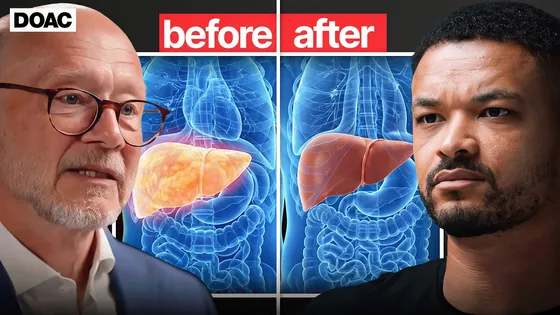
Dr. David Unwin says 93 percent of his prediabetes patients normalized blood sugar on low carb
The British GP makes a strong case for treating fatty liver and prediabetes earlier, but his blockbuster number comes from practice data, not a universal guarantee.

Gastroenterologist Will Bulsiewicz says gluten intolerance is mostly a misdiagnosis, and the real culprit is a carbohydrate called fructans
The gut doctor behind a bestselling microbiome book has a study that upends a decade of gluten-free grocery shopping.

Martin Picard says Alzheimer's isn't caused by amyloid plaques, it's an energy disorder
The mitochondrial scientist makes a clean break from the story most people learned about dementia, though his replacement theory needs more humility than the podcast gives it.

Christopher Kerr says nearly 90 percent of dying patients see dead loved ones before death
The hospice doctor’s claim is stronger as end-of-life research than as proof of an afterlife, but it is specific, startling, and harder to dismiss than a campfire story.
The circuit, read weekly. No noise.