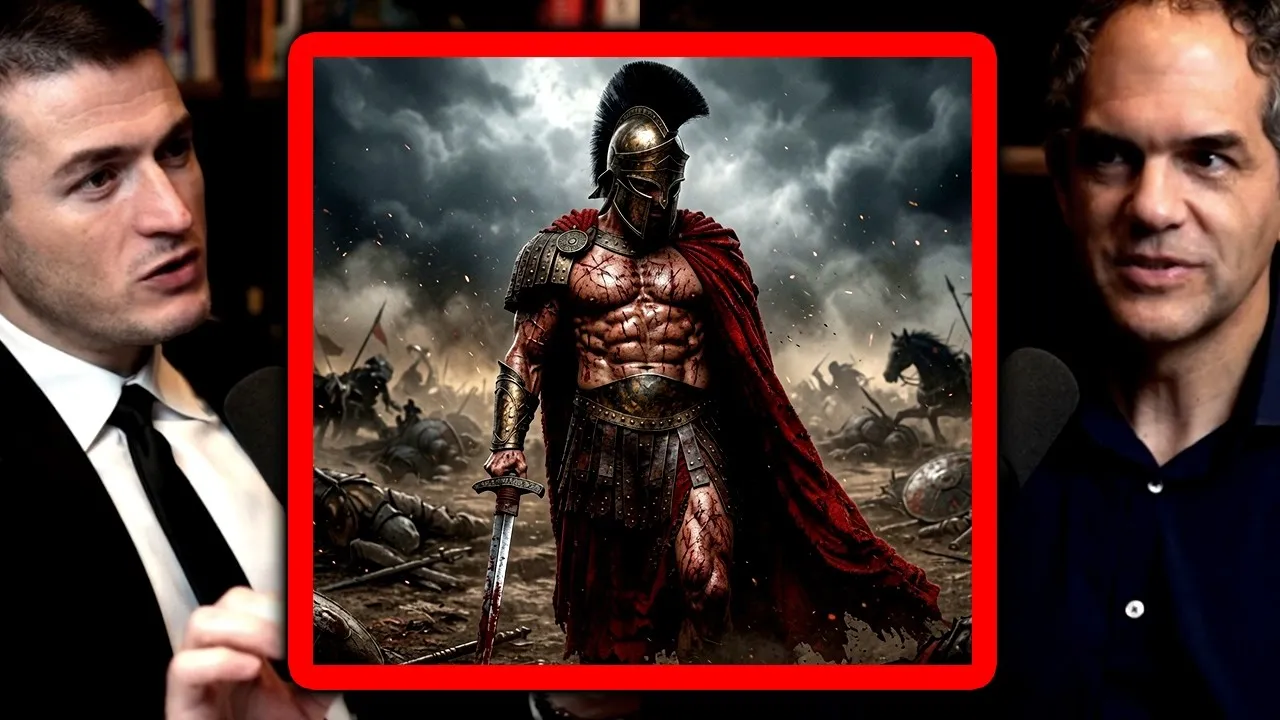
Anthony Kaldellis says 46 percent of Constantinople's emperors were overthrown through violence
The Byzantine historian argues that riots, coups, and civil wars were not glitches in the East Roman system, they were the brutal pressure valve that kept emperors nervous.
Listen on YouTube · Spotify · Apple Podcasts
 WATCH NOW↓
The emperor of Constantinople didn’t just need charisma, grain, and a good hat. According to Anthony Kaldellis, he also needed to remember that nearly half of his peers were overthrown through violence, which is one way to make approval polling feel a little more urgent.
On the Lex Fridman Podcast, Kaldellis makes the Byzantine Empire sound less like a marble postcard and more like a thousand-year stress test for executive power. His claim is blunt: riots, coups, and civil wars were not weird exceptions. They were part of how the system corrected itself, sometimes with a monastery, sometimes with a blinding, sometimes with the medieval customer-service option of cutting off an emperor’s nose.
just take the the thousand years that I study. Uh there’s something like 120 civil wars.
That number matters because Kaldellis is not describing ideological civil wars in the modern sense. These were fights over who got to hold power, not whether the state should be monarchy, socialism, or a chariot-based content platform. Same imperial language, same basic political theology, different guy trying to sit on the throne.
Something like 46% of the emperors of Constantinople are overthrown through violence. 46%.
The emperor had absolute power, except when everyone hated him
This is the useful crack in the old cartoon of Byzantium as pure despotism. Institutionally, the emperor looks enormous. In practice, Kaldellis argues, he is always listening for the sound of the crowd going cold. An emperor could command armies and taxes, yes. He also had to appear in public and find out whether 100,000 people in the Hippodrome felt like chanting nicely today.
We just call it a perpetual referendum, right?
That phrase is sticky because it does two things at once. It makes the empire feel strangely modern, all vibes, approval signals, and live audience feedback. It also reminds you how spoiled modern politicians are by fixed terms. A president can be unpopular and still legal. A Constantinopolitan emperor who misread the crowd could become a cautionary object lesson with a missing facial feature.
Kaldellis gives the Hippodrome the role cable news wishes it had: the place where the ruler found out, in real time, whether policy was about to survive contact with the public. Chariot racing was only part of it. The Hippodrome was a political theater, a stadium-sized comment section, and unlike the internet, it could walk to the palace.
His best example is Alexios III in the 1190s, facing pressure from the German emperor and trying to raise money through what Kaldellis calls the German tax. The emperor floats it before the people. The people hate it. The policy evaporates with comic speed.
that wasn’t my idea. Uh but I don’t know where that came from. No, never mind. We’re not going to have the German tax.
Call it democracy if you want, but don’t get sentimental
Lex Fridman pushes the comparison to modern democracy, and you can see why. The public had a connection to the ruler. Leaders responded to pressure. The people could gather, chant, boo, demand, and occasionally end careers with terrifying directness. If democracy means some living feedback loop between the governed and the governor, Constantinople had one.
But the comparison has limits, and they are not tiny. Ballots are slow, boring, and blessedly low on mutilation. Kaldellis’s version of public accountability depends on political violence, military pressure, and crowd energy that could turn lethal. Calling that democracy is tempting in the same way calling a shark a lifeguard is tempting. It is in the water, and it does change behavior.
The verdict here is not that the East Romans secretly invented a better system than modern elections. Kaldellis is careful about that. His stronger point is historical, and better: the empire lasted because imperial power was never as absolute as it looked on paper. The emperor governed under constant threat from the people, the army, rival elites, and the possibility that some ambitious man would walk down the Mese and discover whether the crowd wanted a new boss.
If Kaldellis is right, the lesson is ugly but clarifying. Stability did not come from everyone agreeing to be peaceful. It came from rulers knowing that bad government could become a very personal problem, very fast.
- Did Anthony Kaldellis say the Byzantine Empire was a democracy?
- Not exactly. He accepted that Constantinople had real popular pressure on rulers, especially through crowds in the Hippodrome, churches, armies, and public spaces. But he framed it more as consultation and consensus testing than as democracy in the modern ballot-box sense.
- What did Kaldellis mean by a perpetual referendum?
- He meant that emperors never got to bank legitimacy for a fixed term. Public cheers, boos, riots, and support for rebels constantly tested whether an emperor still had enough backing to survive.
- Why does the 46 percent number matter?
- Because it changes the image of Byzantine rule from simple autocracy to a system where emperors were powerful but exposed. If almost half of Constantinople's emperors could be removed violently, then fear of the crowd, the army, and rival elites was not background noise. It was the job.
Anthony Kaldellis says Rome’s three biggest disasters were the Arab conquests, the Seljuk conquest of Asia Minor, and the Fourth Crusade
The Byzantine historian’s Roman Empire is not a marble statue collapsing in 476, but a long-running state repeatedly injured by three fast, brutal shocks.
Anthony Kaldellis says Byzantine Greek fire came in hand grenade form
The historian’s best detail on Lex Fridman was not just that Greek fire burned on water, but that the Romans apparently bottled the stuff and threw it at siege engines.
Anthony Kaldellis says Diocletian ended Italy’s tax haven and made taxation the core of the Roman state
The Byzantine historian’s best line on Lex Fridman is not that Diocletian invented the deep state, but that he made the conquerors finally pick up the tab.
Anthony Kaldellis says the Plague of Justinian probably did not kill half the Roman Empire
The historian's case is brutally practical: if half the empire died, why did Justinian's wars, taxes, and courts keep running?
The circuit, read weekly. No noise.