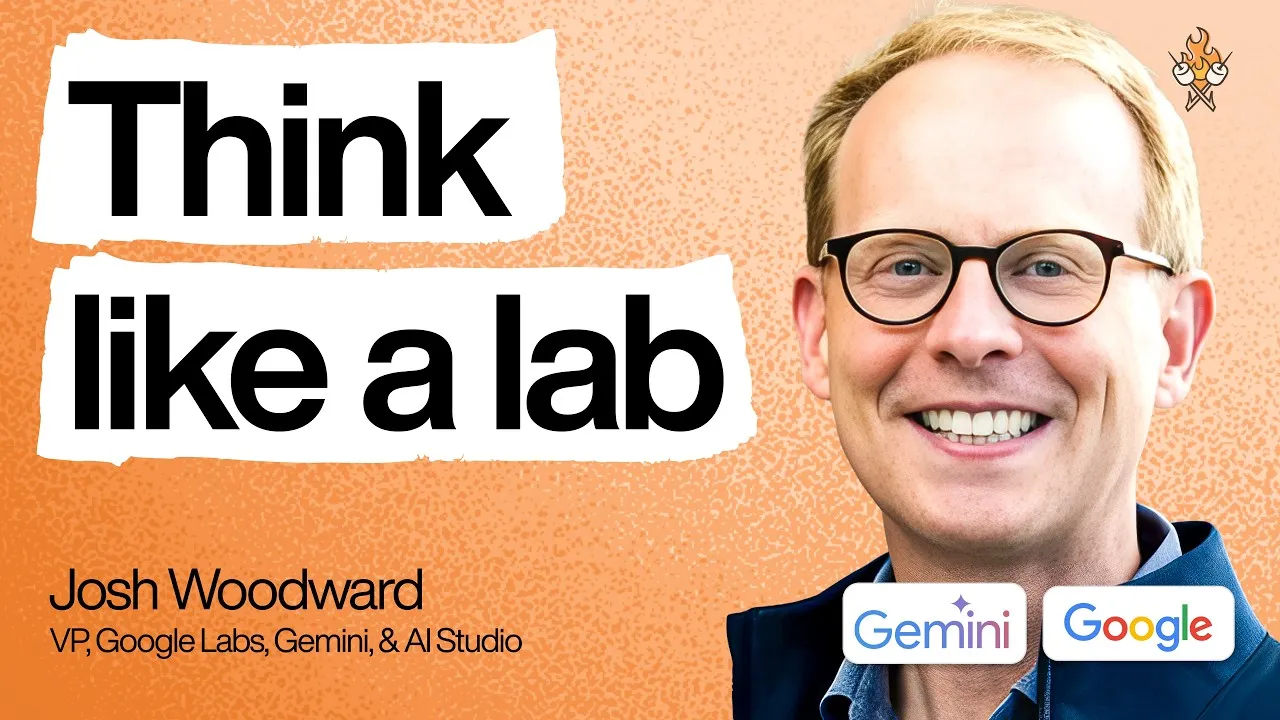
Josh Woodward says corporate labs usually fade after three to four years
The Google Labs VP argues that every company now needs a frontier AI team, but history says those teams usually turn into expensive petting zoos for prototypes.
Listen on YouTube
 WATCH NOW↓
 Josh Woodward, the Google executive running Google Labs, says the dirty secret of corporate innovation labs is that they usually go soft and fade after three to four years. That is the useful part of his appearance on Lenny’s Podcast, not the standard Silicon Valley pep talk about experimenting more with artificial intelligence.
Woodward’s pitch sounds, at first, like every executive offsite deck since someone first put beanbags near a whiteboard: every company needs a lab team. But he gives it a sharper edge. In the AI era, the lab is not a vibe department. It is an early warning system. Its job is to know what just became possible before the rest of the org has scheduled a steering committee to discuss whether possibility is aligned with Q3.
الشركة الكبيرة التي تبدأ مختبراً، غالباً ما يكون المختبر غير فعال ويتلاشى بعد حوالي 3 إلى 4 سنوات.
That is a bleak little sentence coming from the guy whose job title contains the word Labs. It is also basically correct. Big companies love labs the way rich people love rescue dogs, sincerely, photogenically, and often without changing the house enough to make the adoption work. Xerox PARC is the classic ghost story here, brilliant future spotted, someone else gets rich commercializing it. Woodward does not name it, but he is clearly talking about that species of corporate tragedy.
The lab can’t report to the machine it is trying to escape
Woodward’s prescription is autonomy, but not the fake kind where a team gets a funky name, a separate Slack channel, and the same quarterly approval gauntlet as everyone else. He argues that if the lab is simply jammed underneath an existing business unit, the weird ideas die young. The existing business always has a good reason. Revenue. Roadmaps. Sales commitments. Legal review. A VP who has never forgiven whimsy.
ولا يمكنك ببساطة وضع هذا الفريق تحت مظلة وحدة أعمال قائمة. يجب أن يتمتع بنوع من الاستقلالية، هذا أمر أساسي.
The trick, and this is where Woodward sounds less like a guru and more like someone who has actually watched prototypes wander the halls, is that autonomy alone is not enough. A lab also has to connect back to the mothership. Otherwise it becomes a demo zoo. Lovely animals. No business model.
His model is a team close enough to the frontier to be annoying. These are the people trying every new model, tracking almost possible ideas, and pouncing the second a capability crosses over from parlor trick to product substrate. Woodward says the people you want are the ones who cannot stop building.
إنهم الأشخاص الذين لديهم ثمانية اشتراكات بقيمة 200 دولار شهريًا لكل شيء.
That line is funny because it is painfully legible. Every tech company now has at least one person expensing the full menagerie of AI tools and behaving like a raccoon in a server room. Woodward’s point is that this person should maybe not be treated as a distraction. They might be your sensor array.
The verdict is useful, but conveniently pro lab
There is a self serving tint here. When the VP of Google Labs says every company needs a lab, nobody should faint from surprise. This is like a treadmill company discovering that America needs cardio. Still, Woodward’s version is more honest than the usual innovation sermon because he names the failure mode. The lab dies. Or it survives as theater. Or it sees the future and cannot get the company to care.
He is also refreshingly suspicious of brainstorm pageantry. Good ideas, in his telling, do not arrive because someone blocked off Thursday for ideation and ordered the decent pastries. They come from people already messing with things, in hallways, on weekends, during breaks, in the private little fugue state where builders forget to pretend they are off the clock.
نادراً جداً، على الأقل حسب خبرتي، ما تأتي هذه الأفكار من “جلسات التصميم السريعة”
That is the real management challenge hiding inside the AI cheerleading. If every company needs a lab now, most companies will build the wrong one. They will hire too many people, ask for a two year roadmap in a six month world, demand predictable output from a team whose purpose is to find the unpredictable, then wonder why the whole thing feels expensive and vague.
Woodward’s better answer is smaller and harder: give the lab room to be strange, force it to stay useful, and staff it with people who learn fast enough to abandon what they learned last week. If that sounds uncomfortable, congratulations. You have located the point.
- Why does Josh Woodward think corporate labs fail?
- Woodward’s diagnosis is that labs often get either isolated into irrelevance or folded too tightly into an existing business unit. The first version makes clever demos nobody can ship. The second version smothers the weirdness before it can become a real product.
- What does Woodward say a company’s AI lab team should actually do?
- He thinks companies need a small frontier group whose job is to live ahead of the main organization, test the newest models, track what has just become possible, and bring that signal back before a startup does. In his funnier version, these are the people with multiple expensive AI subscriptions and no patience for being 24 hours late to the latest thing on X.
- Is Woodward’s advice only useful for big companies like Google?
- No, but the Google version has Google sized padding. The useful idea is not to copy Google Labs, it is to protect a small team from quarterly product gravity while forcing it to stay connected to real users, real distribution, and real business stakes.
Peter Sellis says the best product teams should be designed like terrorist organizations
The former Snapchat and Discord product chief has a radioactive metaphor for startup org design, but the idea underneath it is less insane than the phrasing.
Anish Acharya says most AI companion users are women in their 40s and 50s
The a16z consumer investor punctured the AI girlfriend cliché and argued that consumer AI's real prize is not productivity, it is emotional need.
Ian Silber says AI is already an incredible product designer
OpenAI’s head of product design makes the case that designers aren’t doomed by AI, they’re late to the most useful tool in the room.
Adam Ward says asking 'who's the best product engineer you know?' is the worst recruiting question
The Cursor head of talent argues that most companies hire from a 'funnel of doom' and end up with whoever was available, not whoever was best.
The circuit, read weekly. No noise.