Sherif Mansour says Atlassian’s AI-builder experiment put PMs and designers back in their old jobs after a month
The Atlassian product leader’s best argument for PMs in the AI era is not romantic, it is organizational plumbing.
Listen on YouTube
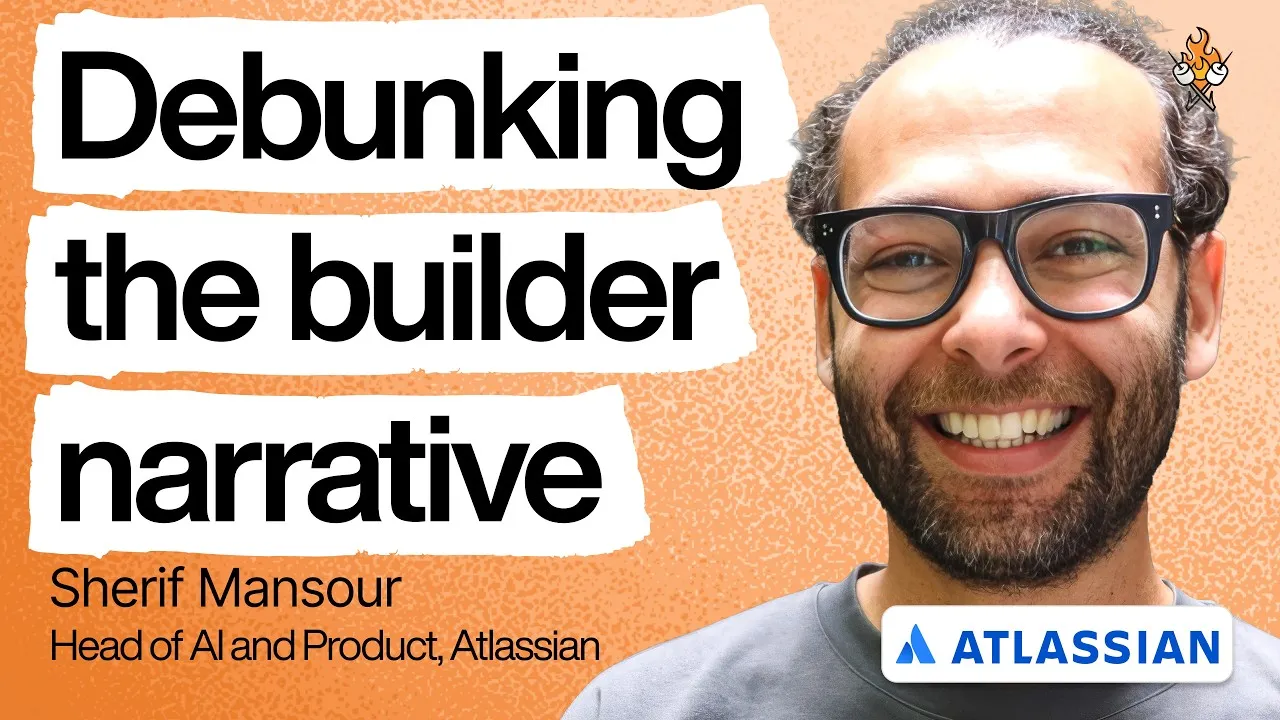 WATCH NOW↓
Sherif Mansour told Lenny’s Podcast that Atlassian tested teams where everyone became an AI builder, with no dedicated PM or designer roles, and within about a month people had gone back to their traditional jobs. His reason was blunt: AI made building faster, but it did not solve the harder problem of deciding what to build.
This is the sort of anecdote that walks into PM Twitter carrying a fire extinguisher. For the past two years, the loudest version of the AI-at-work story has been: everyone is a builder now, product managers should ship code, designers should prototype themselves into oblivion, and the org chart should be replaced by one guy in a hoodie whispering to Cursor. Mansour, who runs AI and product craft at Atlassian, is not buying the hoodie gospel.
There was no PM or designer, but they came from different crafts.
The experiment sounded intoxicating at first. Mansour said one PM told him the team was constantly building and had “moved faster than ever before.” That is the AI drug in its purest form: instant motion, instant dopamine, a backlog turning into vapor trails. Then the hangover arrived.
after about a month he comes back and he’s like everyone’s gone back to doing their traditional jobs.
we realize throughput’s not our problem. Directions are problem. But throughput’s getting cheaper.
The org chart beat the vibe code
Mansour’s argument is not a defense of the lazy PM, the calendar vampire who turns every idea into a 17-comment Slack thread. He is defending a specific job: carrying customer context, product context, market context, and business context so the team can make better decisions faster. Earlier in the episode, he puts it cleanly: PMs do not own all decisions, they own decision-making velocity.
That is convenient, of course. A head of product craft saying product craft still matters is not exactly a monk renouncing worldly goods. But the claim has the sweaty smell of real office life. Faster building does not automatically produce better judgment. It can just create more stuff to argue about in a Google Doc.
because you have access to the tool doesn’t mean you’re an expert at the domain that you have access to
That line is the episode’s most useful cold shower. Mansour compares the AI-builder frenzy to the old Balsamiq era, when easy mockup tools supposedly meant everyone could design. Everyone could make a mockup, sure. A lot of those mockups were bad. His point is that artificial intelligence expands people’s reach, but it also expands their bad taste, weak judgment, and pet theories. The circles get bigger. They do not magically become the same circle.
The junior twist
Mansour’s second-best provocation is that companies are wrong to stop hiring juniors because AI can do junior work. This is where the episode gets less “protect the PM guild” and more interesting. He says Atlassian has overindexed on juniors because new entrants often bring different AI habits into an older workforce.
one misconception I’m often debunking with a lot of established organizations is you don’t need to hire juniors anymore.
His home example is almost too neat, but it lands: his 12-year-old son skipped from Scratch straight to vibe coding games, treating model-switching and AI-assisted building as normal childhood weather. The trade-off, Mansour says, is that juniors are worse at spotting AI slop because they lack domain experience. Seniors spot the slop. Juniors bring the new working style. Congratulations, we have reinvented the obvious and somehow it feels radical: mixed teams are good.
So, is he right?
Mostly, yes. The weak version of the claim would be that PMs can ignore code and retreat to strategy theater. Mansour does not say that. He says PMs should use AI where it increases decision-making velocity: customer research, market analysis, prototyping a vision, filling context gaps. The strong version is that in large software organizations, more output is not automatically progress. It is just a faster way to make a mess.
That also fits the hiring wrinkle Lenny Rachitsky raises: according to his current tech job-market work, PM roles appear to be doing better than engineering, design, and user research roles. Mansour’s explanation is simple enough to annoy everyone: when AI cheapens production, steering becomes more valuable.
If you are a PM, the practical move is not to become a bargain-bin engineer. It is to prove you can direct the ship when everyone else has been handed a bigger oar.
- What did Sherif Mansour say about AI builders?
- Sherif Mansour said Atlassian tested teams where everyone acted as an AI builder, without separate PM or designer roles, and the experiment initially felt incredibly fast. After about a month, he said, people drifted back into their traditional jobs because the team realized speed was not the real constraint. The problem was direction, which is exactly the sort of work PMs and designers are supposed to provide.
- Did Sherif Mansour say PMs should not code?
- No. Mansour’s point was not that PMs should avoid AI tools or never touch code. He argued that in mature organizations, the bottleneck is usually not how fast someone can produce software, but whether the team has the right context and judgment to choose the right work.
- Why does Mansour think juniors still matter in the AI era?
- Mansour pushed back on the idea that AI makes junior employees unnecessary. His argument is that younger or newer workers often bring AI-native habits into established teams, while seniors bring domain judgment and quality control. The useful team is not all juniors or all seniors, it is the pairing.
Josh Woodward says corporate labs usually fade after three to four years
The Google Labs VP argues that every company now needs a frontier AI team, but history says those teams usually turn into expensive petting zoos for prototypes.
Mona Sarantakos says Meta nearly killed Muse’s Jolly avatar a week before launch
The Meta product lead’s best story is not about model evals, it is about a stuffed creature surviving the corporate immune system.
Emmanuel Ameisen says Claude can make hidden plans before it writes
The Anthropic interpretability researcher says the “next token” machine sometimes carries a backstage plan, which is not consciousness, but is also not your iPhone autocomplete.

Peter Sellis says the best product teams should be designed like terrorist organizations
The former Snapchat and Discord product chief has a radioactive metaphor for startup org design, but the idea underneath it is less insane than the phrasing.
The circuit, read weekly. No noise.