The Diary of a CEO's unnamed war expert says a US strike on Iran's power plants would be worse than a nuclear weapon
The claim is less prophecy than pressure-test, but it reveals how quickly grand strategy can start sounding like a hostage note.
Listen on YouTube · Spotify · Apple Podcasts
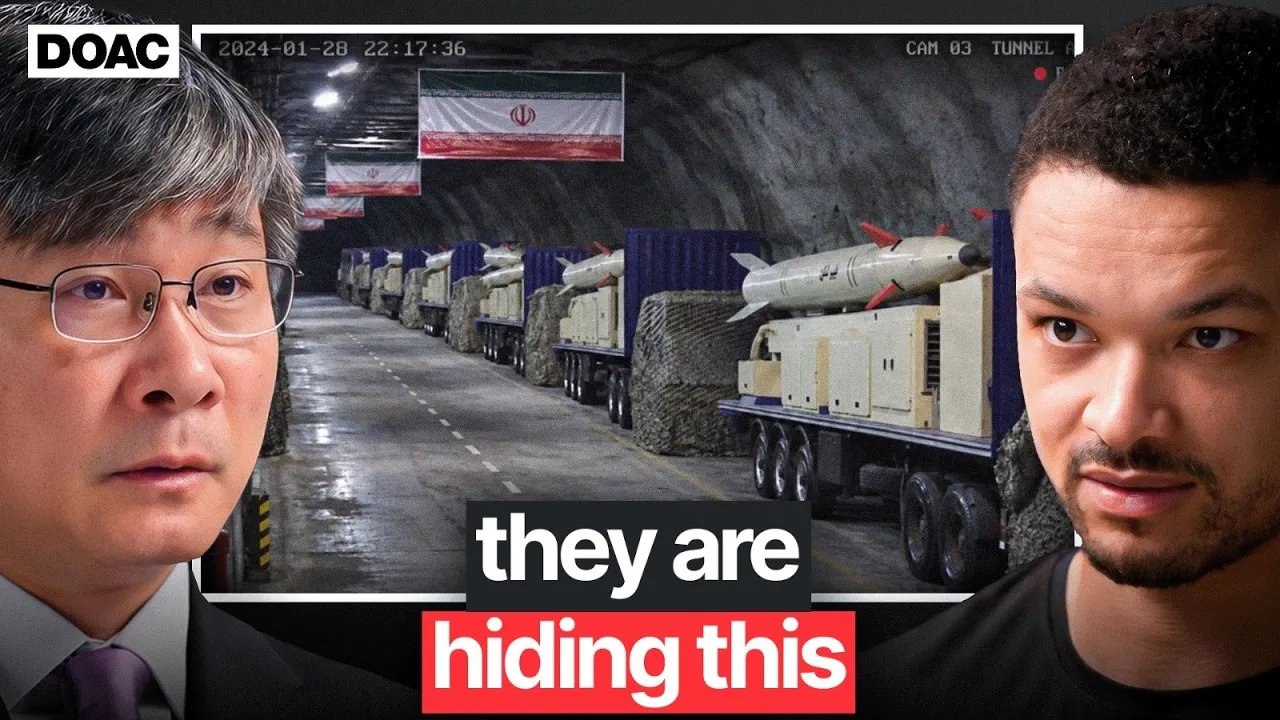 WATCH NOW↓
 The nightmare scenario here is not a mushroom cloud. It is a refrigerator going warm in Tehran. On The Diary of a CEO, an unnamed war expert says a United States strike on Iran’s power and desalination infrastructure would be “worse” than a nuclear weapon, because it could starve a city of roughly 10 million people without the cinematic convenience of a single blast.
That is the line built for clipping, arguing, and immediately texting to the group chat with the caption, “Is this guy serious?” He is serious. Maybe too serious. The guest’s whole model treats Iran less as a country than as a control panel for global trade: Strait of Hormuz here, Houthis there, Hezbollah near the Suez Canal, shipping insurers quietly sweating in the corner.
وهذا الرد يتمثل في مهاجمة البنية التحتية المدنية الحيوية لإيران، والتي تشمل محطات تحلية المياه ومحطات الطاقة. وهذا سيكون أسوأ من استخدام سلاح نووي ضد إيران.
The phrase “worse than nuclear” is doing two jobs. One is analytical: modern societies can be broken by attacking the systems that keep water flowing, food cold, and hospitals functioning. The other is pure podcast accelerant. It makes a grim infrastructure argument sound like the trailer for a prestige apocalypse drama starring a map of the Persian Gulf.
The scary part is not the bomb, it is the spreadsheet
The guest’s theory starts with global supply chains. Semiconductors need helium, rare earths, high-grade quartz. Fertilizer depends on ammonia production concentrated in the global north. Food, chips, robots, smartphones, all of it sits on trade routes and insurance contracts that most people never think about until the shelves get weird.
From there, he walks into Iran. His argument is that Tehran’s best move, if cornered, would be to inject enough chaos into maritime trade that insurers stop pricing risk like adults and start pricing it like gamblers in a burning casino. That is a real vulnerability. Shipping does run on confidence. Insurance is not glamorous, which is why it matters. Nobody writes an action movie called Marine Underwriting, but civilization quietly depends on it.
إذا لم تستطع التأمين على الشحن العالمي، سيتوقف الشحن العالمي عن العمل.
The jump comes next. If Iran attacks the logic of trade, he says, the United States attacks the logic of life inside Iran: power, water, refrigeration. That is where the claim becomes both chilling and self-consciously brutal. The guest is not merely saying leaders can make immoral choices. He is saying the structure of power pushes them there.
أعتقد أن الولايات المتحدة ستُجبر على القيام بذلك.
This is a theory of escalation with the conscience sanded off
The strongest version of the claim is this: civilian infrastructure is no longer background scenery in war, it is the target set that actually decides whether a state can function. That part is persuasive. Power grids, desalination plants, ports, cables, and refineries are the organs of modern life. Hit enough of them and you do not need to occupy a capital to make a society suffer.
The weaker part is the inevitability. “Game theory” can be a useful tool, but here it also becomes a moral dry cleaner. Feed in prestige, deterrence, empire, and oil routes, then out comes mass civilian suffering with all the emotional texture of a chess puzzle. The guest knows this, which is why his Trump role-play sounds so ghastly. He is trying to inhabit the mind of a leader who cannot afford to look weak, and the result is less Pentagon memo than villain monologue with footnotes.
سأخوض المواجهة بكل قوتي. سأبدأ بمهاجمة محطات الطاقة في إيران.
There is context that makes the warning land. The Middle East really does contain chokepoints that can rattle energy markets. The Strait of Hormuz is not some obscure Risk board territory. Water and energy infrastructure are already the kind of systems strategists obsess over because they turn military pressure into civilian panic. Add water scarcity, aging Western societies, migration pressure, and fragile supply routes, and you get the guest’s bleak worldview: everything is connected, and that is precisely the problem.
But connected is not the same as predetermined. Calling a strike on power plants “worse than nuclear” is a useful alarm bell and a suspiciously shiny headline. It compresses law, morality, military necessity, civilian harm, and political choice into one catastrophic sentence. The moral danger is that listeners come away thinking apocalypse is not chosen, it is merely calculated.
The concrete stake for the listener is not whether this exact scenario happens next week. It is whether we can still hear the difference between analysis and permission. Because once a guest starts describing mass starvation as the rational move, the map is no longer the frightening object in the room. The calm voice is.
- What exactly did the war expert claim about Iran?
- He claimed that if Iran moved to disrupt global trade, the United States could respond by attacking Iran's critical civilian infrastructure, including power stations and desalination plants. He said that would be worse than using a nuclear weapon against Iran because it could produce mass hunger and social collapse in a city like Tehran.
- Was he saying the United States will definitely attack Iran's power plants?
- Not quite. He refused to make a firm prediction about every step, but he did say escalation is his expectation and that game theory points toward the United States feeling compelled to hit harder if global trade is threatened.
- Why does global shipping matter in his Iran scenario?
- His argument is that Iran and its allies do not need to win a traditional battlefield victory. If attacks around Hormuz, the Red Sea, or nearby routes make insurers unwilling to cover ships, global shipping can seize up, and the United States loses the confidence that underwrites its power.

Cenk Uygur says Israel blocks an Iran peace deal every time Trump moves toward peace
On The Diary of a CEO, Uygur argued that Trump has a deal available with Iran, but Benjamin Netanyahu keeps pushing him back toward war.
Cenk Uygur says Israel gave America a list of seven countries to attack after 9/11
The Young Turks host turns a Diary of a CEO Iran debate into a blunt accusation about U.S. foreign policy, while Kevin O'Leary argues the real issue is stopping Iran from getting a bomb.
Nate Soares says humanity would be lucky to have 10 years unless we stop building superintelligence
The AI safety researcher’s doomsday clock is blunt, but his stronger argument is that a global pause might actually be enforceable because frontier AI training is huge, scarce and visible.

Brian Greene says by the time we see an AI intelligence explosion, it may be too late to stop it
The physicist is not buying every 2029 superintelligence prophecy, but he thinks the math of exponential growth is exactly what makes AI risk so nasty.
The circuit, read weekly. No noise.