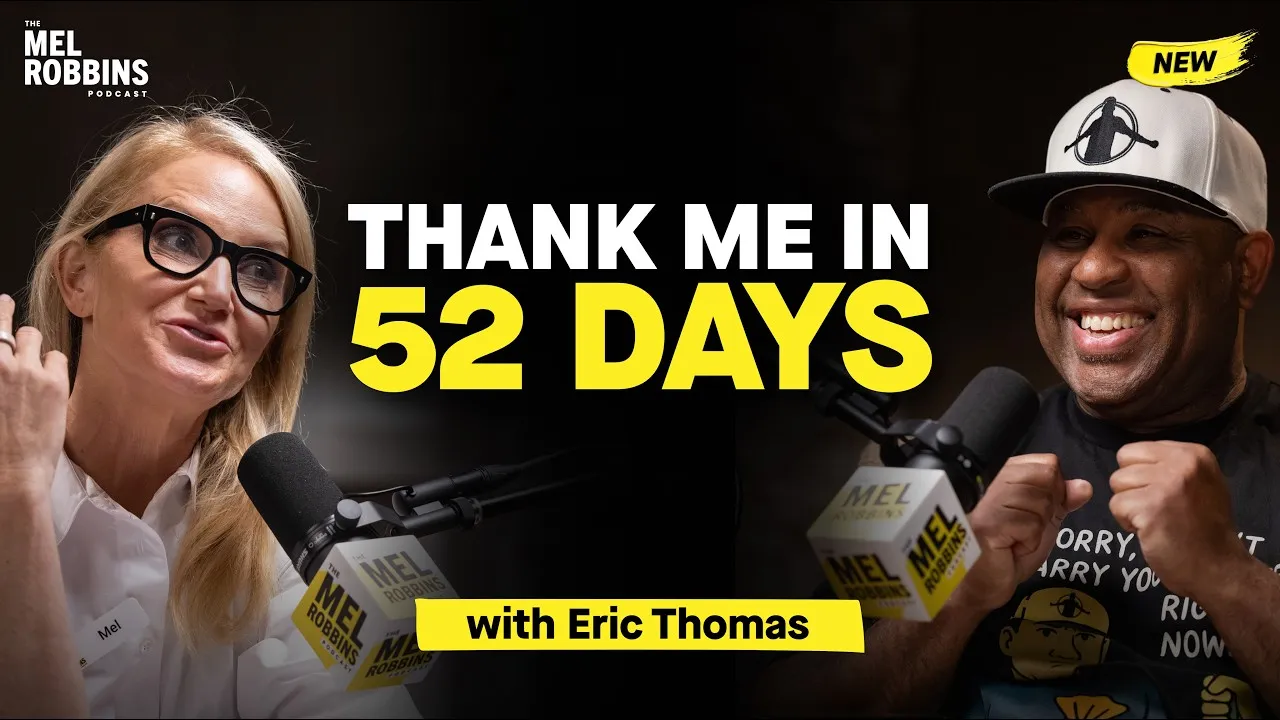
Eric Thomas says his 52-day challenge helped him go from 242 pounds to 219
On The Mel Robbins Podcast, the motivational speaker turns a biblical number into a very modern reset plan, complete with a scale, a suit, and a little public shame.
Listen on YouTube · Spotify · Apple Podcasts
 WATCH NOW↓
Eric Thomas told The Mel Robbins Podcast that his 52-day challenge helped him go from 242 pounds to 219 after he faced prediabetes, prehypertension, and mild sleep apnea. Eric Thomas’s larger claim is that 52 days is enough time to stop drifting, rebuild self-respect, and get back to your best self.
That is classic Eric Thomas, part locker-room sermon, part Fitbit exorcism. The man does not gently suggest. He detonates. But under the volume, and there is volume, the idea here is surprisingly concrete: pick the area that embarrasses you, put the proof in front of your face, schedule the fix, and make it non-negotiable.
Everything could change in 52 days. Everything could change. And more importantly, everything you want to change can change in 52 days.
The 52-day number isn’t random, at least not in Thomas’s telling. He ties it to Nehemiah, the biblical figure whose people rebuilt a wall in 52 days after it had been down for roughly 140 years. Fine, that is a very motivational-speaker origin story. Somewhere, a whiteboard just burst into flames. Still, Thomas is smart enough not to sell 52 days as a superhero montage. His better line is that you’re not always trying to become someone new. Sometimes you’re trying to get back to the version of you who already existed before the drift.
The scale is the villain, until it becomes the map
Thomas says his own target was health. Not vague wellness. Not vibes. He says doctors were using words he hadn’t heard before, including high blood pressure and the possibility that he could stroke out. He looked at old photos, old clothes, even the suit from his 21st-year vow renewal with his wife, and realized he had been negotiating with reality like it was a cable bill.
I changed my diet. I changed my mindset. I got on the treadmill. I was doing resistance. I was in the sauna.
This is where the claim gets useful. Thomas says he didn’t win by discovering a secret. He won by stealing from the parts of his life that already worked. Speaking? Scheduled. Marriage? Intentional. Career? Measured. Health, by contrast, had become vibes in sweatpants. So he put it on the calendar. He told friends to check on him. He stopped letting other people’s preferences, including his wife’s travel anxiety, cancel his workouts.
The verdict: the biology is not one-size-fits-all, but the behavioral math is solid. Fifty-two days won’t fix every blood marker, debt spiral, relationship pattern, or anxiety loop. Anyone promising that should be forced to eat a laminated vision board. But 52 days is plenty of time to build a visible streak, expose the lie that you have no control, and create enough evidence that your brain starts believing you again. That is the whole engine of self-improvement, minus the scented candle fog.
The day you see 242 is the day 219 comes alive.
His real advice is not inspiration. It is embarrassment.
The sneaky, uncomfortable part of Thomas’s system is what Robbins calls the embarrassing inventory. Look at the thing you keep hiding. The weight. The debt. The complaining. The house. The posture. The fact that you don’t know how to cook and DoorDash has become your legal guardian. Thomas doesn’t treat embarrassment as proof that you’re doomed. He treats it as the first honest data point.
the actual secret to success is really transparency.
That is not gentle advice, and it can curdle if you hear it as shame theater. Thomas talks about firing the old version of yourself, calling your current state embarrassing, and refusing to hide from the scale. For some listeners, especially anyone with a complicated history around food or body image, that language is going to clang. But Thomas is not really selling humiliation. He is selling contact with the facts. In weight loss, as in money, work, or habits, the avoided number tends to run the room.
His personal story gives the sermon some ballast. Thomas talks about being homeless, going to jail as a teenager after a traffic stop involving a stolen car and substances he says were not his, and realizing that blaming his mother, his biological father, school, or circumstance had become a full-time job with terrible benefits.
homelessness was the best thing that ever happened to me.
That line is jarring, and Thomas knows it. His point is not that hardship is secretly cute. His point is that solitude stripped away his audience. He says he had wanted attention more than opportunity, witnesses more than change. Once he stopped using pain as a microphone, he could use it as information.
The useful version of the 52-day challenge
Thomas’s plan is simple enough to survive contact with a Tuesday. Pick an area with a real return. Find a picture or number that shows where you want to go. Schedule the daily action. Start small enough that your body doesn’t revolt. Tell someone, because apparently many of us will betray ourselves before we inconvenience a friend. This is not glamorous. Good. Glamour is how bad plans wear cologne.
The best part of Thomas’s pitch is that he doesn’t ask listeners to wait for rock bottom. You don’t need a cinematic collapse. You can begin with the smaller, uglier truth that you’re tired of being this version of yourself. If the 52-day promise is inflated, the next 52 days are still real. Spend them on purpose or spend them scrolling while calling it recovery.
You owe you to look at the hand that you’ve been dealt and play it.
- What did Eric Thomas say about his 52-day challenge?
- Eric Thomas told Mel Robbins that 52 days was enough time for him to confront his health, step on the scale at 242 pounds, and work his way back toward 219. He says the challenge worked because he stopped treating health as optional and started scheduling workouts, tracking food, using accountability, and borrowing discipline from areas of life where he was already successful.
- Why does Eric Thomas use 52 days as the time frame?
- Thomas says the idea comes partly from the story of Nehemiah, where a wall that had been down for generations was rebuilt in 52 days. For him, the point isn't magical numerology. It's that less than two months is short enough to feel doable and long enough to rebuild trust with yourself.
- Does Eric Thomas think everyone can transform in 52 days?
- He thinks everyone can change their mindset and behavior in 52 days, even if every result doesn't arrive that fast. That is the useful version of the claim. The less useful version is the motivational-speaker fireworks, where 52 days starts sounding like a universal refund policy for regret.
Daniel Pink Has 26,000 Regrets to Show You, and That's the Good News
The author of 'The Power of Regret' joins Mel Robbins to make the case that the emotion you've been running from is actually the most useful one you have.

Mel Robbins says never being single from age 13 delayed her healing by 15 years
On a daughter-led relationship episode, Robbins turns her own romantic history into a warning against using love as emotional anesthesia.
Ed Mylett says two cardiac events pushed him out of interviews for almost two years
On The Mel Robbins Podcast, the self-help maximalist says his body forced the slowdown his ambition refused to choose.

Dr. Lara Boyd says your brain changes most when you succeed only 50 to 60 percent of the time
The neuroscientist turns the usual self-help command to “do hard things” into something more precise, and more annoying, your brain likes the zone where you’re barely making it.
The circuit, read weekly. No noise.