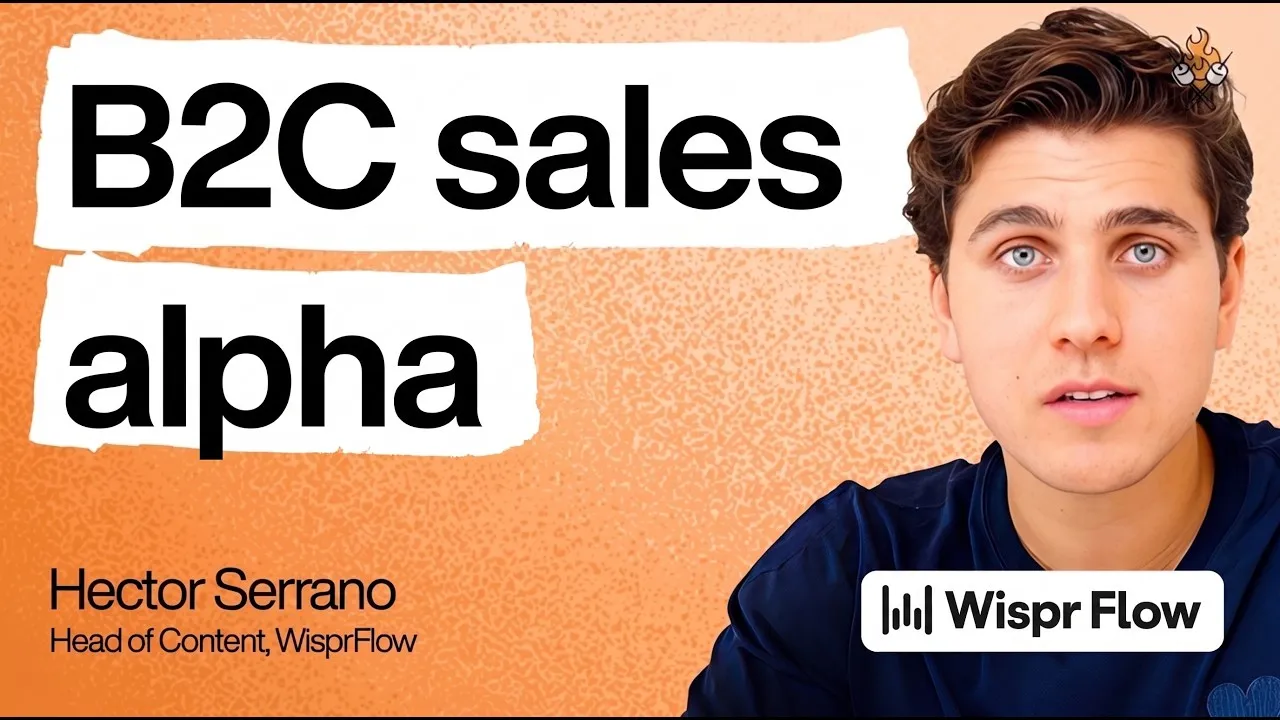
Hector Serrano says Wispr Flow has creators making $13,000 a month from paid UGC ads
The Wispr Flow marketer argues that the best SaaS ad machine right now is not a celebrity endorsement, it is a tight roster of unknown creators paid like upside-seeking partners.
Listen on YouTube
 WATCH NOW↓
Hector Serrano said on Lenny’s Podcast that Wispr Flow has paid UGC creators making about $13,000 a month by giving them an uncapped, performance-based cut of successful ads. His claim is that the best SaaS growth ad right now may not come from a famous influencer at all, but from a product obsessive with a camera, a weird idea, and maybe 1,000 followers.
That is the useful little grenade inside an episode otherwise dressed as a tactical B2B SaaS growth clinic. Serrano is not selling the old influencer fantasy, where a blue-check person holds up a product and pretends the direct deposit hasn’t already cleared. He is selling something more interesting and more cynical at the same time: a creator bullpen, paid like salespeople, treated like community, and constantly fed into Meta until the algorithm says thank you or please stop.
Hector Serrano is a good messenger for this because he is almost comically built for the argument. He joined Wispr Flow at 19 after quitting Division 1 soccer, applying to roughly 200 creator jobs, and asking founder Tanay Kothari for equity despite having never worked at a startup. Lenny Rachitsky frames Wispr Flow as a company that grew revenue 30x in a year and raised at around a $2 billion valuation. Serrano is careful to say product-market fit came first. Good. Because otherwise this whole strategy is just a very elaborate way to pay strangers to discover your product is boring.
The $13,000-a-month creator is not an influencer
The model Serrano described is simple enough to be dangerous. Wispr Flow recruits creators into a private group, gives them room to make ads, runs those ads as paid creative, and pays based on performance. For SaaS, he likes a percentage of ad spend, especially when attribution is fuzzy. For ecommerce, he says percentage of GMV makes more sense. The creator gets a piece of the action. The company gets a lot of ad creative without forcing one tired in-house marketer to become a content hamster in fleece.
It’s like it’s truly uncapped. If they have really good videos and they put a lot of effort in, we have creators now that are making like $13,000 a month.
The number is the flashy part, obviously. Thirteen grand a month is the kind of figure that makes every college kid with a ring light suddenly call themselves a strategic creative partner. But the more important part is Serrano’s disdain for the normal brand-creator transaction. He says Wispr Flow uses smart retainers, for example $1,500 for 25 videos, so a new creator is not crushed if their first month only produces $500 in commissions. If they earn $3,000 in commissions, they keep the commissions and do not get topped up. It is downside protection with upside. A tiny options package, but for people filming ads in their bedrooms.
That structure matters because the old UGC system often pays creators like disposable vendors. Make the video, take the $100, vanish into the spreadsheet. Serrano wants the opposite: a small roster, weekly calls, Discord culture, fast payouts every seven days, and creators who actually use the product. Wispr Flow has about 50 creators, he says, and he claims the program now attracts 1,000 to 1,500 applications a week. That is not a side hustle. That is a farm system.
The ugly ad is the point
The best detail in Serrano’s pitch is that he does not romanticize beautiful advertising. He says some of Wispr Flow’s best ads are ugly, long, and painfully direct, especially for older or more technical audiences. One winning ad, he says, involved a creator leaving a keyboard outside in the rain so the raindrops could “type” the prompt to download Wispr Flow. This is either genius, nonsense, or the exact midpoint where modern performance marketing lives.
His actual operating theory is smarter than “make weird stuff.” He wants creators who speak to specific buyers: lawyers, moms, engineers, agency owners, sales reps, even an eight-figure ecommerce founder who apparently just loves Wispr Flow enough to make ads. The mistake, he says, is assuming UGC means college kids with iPhones. For a developer tool, the user-generated ad may need to come from an older technical person. For a $3,000 sleep product, the pitch probably should not come from an 18-year-old who looks like he just discovered REM cycles last Thursday.
people mistake UGC for thinking it’s just college kids making content, but UGC is user-generated content and if you’re a dev tool, your user’s probably going to be an older technical person
This is where the claim gets sturdier. Serrano is not saying every founder should grab 50 TikTok kids and let them freestyle enterprise software. He is saying that in B2B SaaS, companies still sell to individual humans, even when the invoice eventually says enterprise. A person sees the ad, tries the tool, tells a coworker, and the account can expand from there. That is a credible argument for product-led software. It is less convincing for giant procurement-led categories, where the buyer’s main content format is a security questionnaire.
His anti-influencer take is the real tell
The funniest and most revealing thing Serrano says is that the best creators may be the ones without much audience. In the old creator economy, follower count was the scoreboard. In Serrano’s version, too many followers can make you look like a walking affiliate disclosure. The less famous the face, the more the ad can pass as a human recommendation rather than a scheduled obligation.
I almost think that creators with no following end up being better investments for brands because influencers kind of are seen now as sellouts a lot of the time
This is also why Serrano’s hiring advice is so tied to youth and taste. He thinks founders should stop looking for polished resumes and start finding scrappy young people who have actually grown an Instagram or YouTube account, even a small one. His suggested signal is not Stanford plus three internships. It is proof that someone understands packaging, consistency, trends, filming, editing, and the strange social physics of why people stop scrolling.
That advice has a bit of founder folklore perfume on it. Every company wants to believe its next growth monster is a hungry 19-year-old waiting to be discovered, not an expensive senior hire with boundaries. Still, Serrano’s own story gives the myth some teeth. He was hired young, got time to be messy, and eventually built systems the company now treats as core growth machinery.
if you just think that throwing money out there and looking for someone with the best grades or the best school or the best experience is going to get you the best hire to run this for you you’re in for a rude awakening
The verdict on the $13,000 claim: believable, but not portable in the lazy way people will want it to be. Wispr Flow appears to have the ingredients that make this work: a product people like, enough paid spend to feed the machine, enough brand heat to recruit creators, and a content lead who understands creators because he is one. Strip those away and the playbook becomes a Discord full of underpaid people making 25 videos no one wants to watch.
Serrano’s sharpest warning may actually be about AI. He argues that the final creative people see should still have humans all over it, especially for an AI company trying not to look like it replaced its own taste with a slop cannon. That is the odd little twist of the whole episode: the young growth savant at an AI company is telling marketers the arbitrage is human mess, human specificity, human faces, human rain on a keyboard.
If we on the other side go out and start making AI slop ads and videos with AI influencers and I don’t know AI designs and AI statics, it’s probably not going to be received really well
- What did Hector Serrano say about paid UGC creators?
- Hector Serrano said Wispr Flow has creators making about $13,000 a month through paid UGC ads. His larger point is that creators perform better when they are not boxed into rigid briefs or flat fees, but given uncapped upside tied to how their ads perform.
- How does Wispr Flow pay its UGC creators?
- Serrano described a performance-based system with a safety net. Creators can earn a percentage of ad spend for SaaS campaigns, or GMV for ecommerce-style products, while newer creators may receive a smart retainer if their commissions are still low.
- Does Hector Serrano think influencers are better than small creators?
- No. Serrano argued that creators with little or no following can be better investments because they feel less like professional pitch machines. The ad looks more like a real person explaining a product and less like a celebrity grabbing a check.
Rob Snyder says design partners almost never help startups find product-market fit
The Power of Pull author argues that the beloved startup design partner is often a false positive with a calendar invite.

Josh Woodward says corporate labs usually fade after three to four years
The Google Labs VP argues that every company now needs a frontier AI team, but history says those teams usually turn into expensive petting zoos for prototypes.
Emmanuel Ameisen says Claude can make hidden plans before it writes
The Anthropic interpretability researcher says the “next token” machine sometimes carries a backstage plan, which is not consciousness, but is also not your iPhone autocomplete.
Peter Sellis says the best product teams should be designed like terrorist organizations
The former Snapchat and Discord product chief has a radioactive metaphor for startup org design, but the idea underneath it is less insane than the phrasing.
The circuit, read weekly. No noise.